


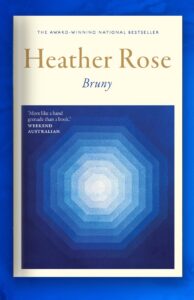
Just when you thought you’d escaped a possible future, it’s back – in this beautiful new design.
Family, intrigue, politics, globalism and the rare beauty of a remote home …
Described as ‘more a hand grenade than a book’ by Rohan Wilson in The Australian – here is Tasmania on the world stage … while Tasmanians do their best to do what they are good at. Remaining loyal to the islands we love. First published in 2019.
Winner of the 2020 <strong>Fiction Book of The Year</strong> in the Australian Book Industry Awards.
Shortlisted for the <strong>Independent Booksellers Book of the Year</strong>
One of Australia’s <strong>Top 10 Bestselling Novels</strong> of 2020
Nominated for one of the best books of the 21st century – https://www.abc.net.au/listen/radionational/countdown/top100books

Readers have flooded me with their reviews of Nothing Bad Ever Happens Here. Thank you to everyone who has written. It has been an immense experience to read your stories, share your emotions, and glimpse your lives. To receive such exquisitely personal accounts and stories has been humbling and beautiful. Thank you all.
Here are a few extracts …
I found it a hugely comforting and inspiring read, Heather. Thank you for writing the things that are scary to write. L
I’ve now read it twice as it moved me so much. I am in awe of not only your writing but your strength and wisdom. T
I read your book in about an afternoon, tears streaming down my face like the rain outside. It has touched me in a way you wouldn’t ever believe, given me hope for my future. In you I saw myself and the beautiful life we live. So delicately connected and intelligent beyond our comprehension. I just wanted to reach out and thank you for this, from the bottom of my heart. T
Your memoir – which I just finished reading – won’t let me go. K
‘I have work to do in the world. Something is calling me.’ These are the words of yours I just read and burst into tears… your words penetrate so deeply through hardened skin. Your story is a balm. Your writing is bringing healing and direction and peace… J
I loved and appreciated your book…I feel that just reading this book has changed my life. I feel humbled in every way… T
Such a beautiful read … thank you for sharing your experiences with us. J
Your description of chronic pain has me undone. I have never read anything so searingly accurate to describe how we live this secret life of pain. You made me cry but somehow I am less alone. M
I read it in 3 days. Your writing is beautiful. C
I just can’t put it down! I just wanted to say thank you for sharing this memoir with us. It’s an amazing journey. D
Such a beautiful read and oh what an amazing journey; I couldn’t put it down! L
I swallowed your book in one beautiful gulp – reading it on a rainy afternoon and evening … I loved it. I cried. I contemplated. Thank you for your vulnerable and enlightening sharing. S
Thank you for writing the best memoir I’ve read. Your writing is always a joy! M
I also have AS and your words and wisdom have helped me so much. I cried and laughed throughout and you have inspired and changed something in my focus for the time ahead. Thank you for sharing your story. H
I just want you to know that I absolutely adored your book. It was such a joy to read. It was like reading a piece of art. Thank you thank you thank you. E
Thank you for sharing your story with us mere mortals. Thank you for having the strength to endure all you have and for embracing and sharing your choice for JOY with us all. E
I just wanted to say how beautiful your (memoir) is… As a painter of the landscape I feel you have done a poetic justice to its omnipotent nature as our backdrop. It was heartbreaking in its quiet beauty but joyous in its adventure. A real hit to the chest. J
This is not your average memoir. Magic. K
I just wanted to say how much I loved Nothing Bad Ever Happens here. It has helped me navigate a challenging time in life. Definitely a read that will stay with me! Thank you. R
Such a wonderful book – deserves every accolade. How hard it must have been to write – let alone live. Sending love. S
I listened to you on audio. I cried, laughed, took notes! A truly transformative memoir which rekindled many memories of my own life. Thank you for writing so truthfully and bravely. S
It’s a beautiful and powerful read. Thank YOU! C
Just finished your memoir. Love the way you seen the world. You’re a gem. R
Just finished your memoir. Oh my – it was authentic, beautiful, vulnerable and raw and I LOVED it. N
I’ve just finished reading your latest book which I found very moving. As an avid reader from an early age, I’ve always felt we should be grateful to people who write books. C
I listened to Nothing Bad Ever Happens Here on Audible over Easter. Wow. So many moments rang true. Your description of spiritual encounters gave words to some of my own encounters. The search, your commitment, your persistence and belief. All inspiring and fitting for me traversing through my Easter break. Thank you. V
I have just finished your memoir and feel moved by your words and the experience of reading it. It was challenging at times …and opened up a wound that I have been desperately band-aiding – and very much need to address. Thank you for giving so much of yourself to us. T
Thank you for Nothing Bad Ever Happens Here. It drew my breath away. C
Just finished reading your memoir – wonderful – thank you for sharing. R
Thank you for the beautiful read. Your words have made such an impact. I’m pondering and reflecting on my own life as I feel them settle in me. K
I have had AS since I was 11 and have never had the words to describe how I feel so people would understand. Reading your memoir made me uncontrollably weep as my feelings were finally validated. I was given your book by a friend who thought it might help me and I don’t think she will ever realise how right she was … so just a huge thank you. E
I just finished your book. How did you know??? So many stories that relate to me and my life!!! I had tears reading it. An amazing book. D
photo – Peter Mathew

Born on the island of Tasmania, Heather Rose falls in love with nature, but a family tragedy at age twelve sets her on a course to explore life and all its mysteries.
Here is a wild barefoot girl keen for adventure, a seeker of truth initiated in ancient rituals, a fledgling writer who becomes one of Australia’s most acclaimed authors, a fierce mother whose body may falter at any moment.
Nothing Bad Ever Happens Here is a luminous, compelling and utterly surprising memoir by the Stella Prize-winning author of The Museum of Modern Love and Bruny. Heartbreaking and beautiful, this is a love story brimming with courage and joy against all odds, one that will bring wonder, light and comfort to all who read it.
After writing eight works of fiction, award-winning author Heather Rose has taken a surprising U-turn and written a memoir. The result is sensational. Nothing Bad Ever Happens Here is a deeply personal collection filled with reflections on love, death, creativity and healing.
When Rose was twelve, her grandfather and brother drowned. The title, Nothing Bad Ever Happens Here, refers to the place where it happened – a place Rose returns to as an adult, a place she finds peace with. This is a memoir about life, death and everything in-between. It’s achingly beautiful and wise. With each chapter, Rose guides us into her life, revealing herself in a way that is both vulnerable and courageous. From premonitions and psychic insight to drug use and exploration of alternative practices, she embraces the great mystery of life – even her own suffering. And in spite of all the struggles she’s encountered, she turns to the light, embracing gratitude and choosing joy.
Beautifully written, as we’ve come to expect from Rose, and truly inspiring, Nothing Bad Ever Happens Here is an absolute must-read.
Author photo – Peter Mathew

The ninth book from Heather Rose, Nothing Bad Ever Happens Here, begins with childhood memories, dark matter musings and Tasmanian bushfires. After learning how quickly death can come, she acquaints herself with the permanent wound of grief, observing the differing means by which human beings deal with loss. Rose, who sees prose as a pathway into the unknown, writes her readers into the darkest crevices of experiential memory – from the deaths of her brother and grandad (and the dream that foretold them) to the guilt of not somehow preventing them.
A childhood of occult curiosity melds into an adventurous adolescence. Rose moves to Asia, travels around Bali, and uses heroin in Koh Samui where drug use is a capital offence. At 19, she moves to a Bangkok monastery, where she studies Buddhism with a monk named Chai. This taste of Buddhist life brings silence, meditation and an awakening awareness to Rose’s quest for meaning. Eventually, she is called back into the mainstream world and experiences the inevitable overwhelm of sudden freedom. She journeys with fellow travellers, herds goats, falls in love and meets royalty. Eventually, a return to Australia brings burgeoning pregnancy, reassuring apparitions and the magic of modern motherhood.
A few years after the birth of her child, Rose visits a sweat lodge where she discovers the power of sun dancing. Dispersing energy between her growing family, a career in advertising and annual trips overseas, she successfully pursues the connection she craves while spending time in the US’s national parks, reservations and motels. Rose’s pipe-carrying proclivities precipitate a series of visions and signs, leading to a loss-and-reclamation of self. The disembodiment, dislocation and disorientation of this period is written with an intense sense of being, and undertones of profound vulnerability.
In her 20s, 30s and beyond, Rose experiences the physical and emotional extremes of human life, variously taking shape in the form of chronic pain, glacial seawater and 70-kilometre treks through the Tasmanian forest with a newly-teenaged son. Rose reframes suffering by removing value judgements – except where she must, in which case the gift must swim into focus. The unearthly lived experience of this fascinating mother/writer/person extends beyond the memoir paradigm, crossing a figurative border between resisting and conducting the forces of life.
In a memoir that is part travelogue, part spiritual awakening, the ripples of Rose’s words flow across each page like rings of hard-won wisdom. More than just a series of musings on chronic pain and prophetic dreams, this book is a meditative doorway towards acceptance. It will resonate with truth-seekers, life-livers and insatiable makers-of-meaning.
Arts Hub
Author photo – Peter Mathew
When a book has the title Nothing Bad Ever Happens Here, you know that something bad is about to happen. Foreboding builds as the first chapters of Heather Rose’s memoir set up an idyllic life in 1960s Tasmania: “Childhood is kelp and sand, birds and sky, and boats pulled up with the tide … Roses of every scent and colour line our front boundary, as if our surname requires it.”
When she is 12, tragedy tears the Rose family apart. Her maternal grandfather and teenage brother, Byron, drown when their fishing dinghy overturns. “Grief turned us into wounded animals,” Rose writes. Her parents divorce and her once-sunny mother withdraws, permanently alienating her elder daughter.
Those losses have shaped Rose’s life and writing, though readers of her diverse novels for adults and children will only understand this now. No wonder the brilliant novel The Museum of Modern Love took its grieving, lonely characters to share silent eye contact with the artist Marina Abramović in her real-life performance at New York’s Museum of Modern Art. Yet, as she writes here, the lyrical childhood was not illusory: nurtured by the Tasmanian environment, family and solitude, reading and writing – “all this lies at the heart of who I will become”.
From the beginning Rose is sensitive to both the natural and paranormal. On page one, she pictures herself at six gazing up at a eucalyptus tree and declaring: “I’m ready. Tell me what to do. Make use of me.” Before the boat accident, she dreams of drowning; afterwards, she has visions of her dead brother.
Rather than collapsing under grief, she begins a restless quest that left me feeling both admiring and perplexed. Superficial comparisons with the bestsellers Wild by Cheryl Strayed and Eat, Pray, Love by Elizabeth Gilbert come to mind, and many other books whose troubled authors find both escape and themselves through travel.
Rose contracts malaria in Bali and seeks oblivion in heroin in Thailand, before settling into a long stay at a monastery. She’s an observant travel writer, evoking the vivid shock of Asian cities and the disciplined routine of meditation that swings from deprivation to bliss.
Back home she is diagnosed with the arthritic condition ankylosing spondylitis, which brings disabling flares of pain. But she refuses to be disabled. She has the first of three children, begins a career in advertising and starts to write fiction: “My writing is terrible.”
After a workshop in a sweat lodge, Rose is told she is “being called to a sun dance”. Knowing nothing about this Native American ceremony, she leaves for New Mexico. Thirty pages describing the sun dance are at the physical and transformative centre of the book. Until now, she has been a spiritual tourist on a sincere but naive search. Here she submits to painful rituals – “the sun dance chief pierces each of my arms four times, then he ties a feather into each wound” – and commits to return for four years.
Her commitment is instinctive rather than intellectual or religious, but it changes her, “honing a sense in me for the unseen, the surreal, the subtle and the intrinsic”. Some readers will find aspects of her exploration bizarre, her adoption of Indigenous practices discomfiting, her acceptance of strange phenomena unexplained. Her endurance can seem like self-punishment.
However, Rose presents her experiences of the “Great Mystery” from the inside, with as much clarity as words can convey. She asks more questions than she answers and does not prescribe her path for everyone. I trusted her as a guide through extreme states for which I have neither desire nor courage.
Nothing Bad Ever Happens Here is a memoir in essays, forming a chronological narrative of personal growth examined from different angles. There are chapters on the end of relationships with her children’s fathers, how she turned her self-healing outwards into anti-forestry activism, how she became an accomplished writer, and how she manages her arthritic pain. Her writing has a vibrant energy, which intensifies and then calms like the widening flow of a river. One of the loveliest if most conventional chapters follows a walk Rose did with her teenage son on the Overland Track in Tasmania’s Central Highlands. The walk is hard, Chris is cranky, but they find a rhythm together and he emerges as a thoughtful young man, immersed in nature.
By the end of her gracefully circular story, Rose has returned to the site of the drownings and learns without irony that “nothing bad ever happens here”. If her final list of advice to readers is simplistic, it is also hard-won. (“Love who you want to be.” “Choose joy.”) Many of us would do well to put aside scepticism and absorb some of her curiosity and gratitude.
November 10, 2022

‘Joy is my daily practice’: Heather Rose on overcoming tragedy and choosing to live a happy life
From dancing into other worlds in North America to losing her vocabulary in the Australian desert, the Stella prize-winning author is taking nothing for granted
The old wooden house looks out over the sea. Standing on the upstairs balcony of Heather Rose’s house is like being on the prow of a becalmed ship.
At the far end of the gently curving Tasmanian beach, forest runs to the sea. Rose swims across this bay at sunrise every morning, even through the frosty months when there is snow on the mountain, in only a bathing suit. Electricity shoots up her arms when she first goes in; her breathing is ragged, but when the shock subsides it is an “elixir of sea and sky”. The cold water leaves her radiant, her face shining with health. It has taught her “a certain fearlessness”.
One morning, back when the author used to wear a wetsuit, a huge fish slid in beside her. It was a dolphin, she writes in her memoir Nothing Bad Ever Happens Here, “regarding me with its huge dark eye”. Then she was in the middle of six dolphins slowing their pace to swim with her. “They are choosing to accompany me.” In the luminous early morning sea the air is filled with rainbows in the spray as the dolphins leap and dive. She thinks this might be death. “I was quite surprised,” she says now, “to see the shore was still there.”
Another day she was on the beach and saw a cloud bank that looked like a bridge to nearby Bruny Island. It would become an actual bridge in her bestselling, sometimes satirical political thriller Bruny, and she would blow it up in the first chapter. That was an idea that came to her at three in the morning and gave her such a fright that she shot straight up in bed.
As a child Rose had spent holidays on Bruny Island. “It was wild and wonderful. It was rare to find another set of footprints on the beach. I remember having to put shoes on again at the beginning of the school year and my feet were so leathery that it would be painful for days trying to squish my feet in.”
To meet Rose is to be enveloped in warmth and joy. “I’m in love with this planet and the people who inhabit it,” she writes in her memoir. But it is not until you come to the last chapters of the memoir that you understand how hard won this has been. Rose has chosen to live with joy.
Rose is a sixth generation Tasmanian. The island and its natural world is in every fibre of her being. She needs this weather to write: “I love weather that glitters off the river as it ambles past.” All of her life she has had visions. When she was 12 she dreamed of a drowning. That same day, her 15-year-old brother Byron and her grandfather drowned in Saltwater River. The tragedy fractured her family; her mother did not come back from her grief, and left the family for another man. Rose says Byron would appear to her and tell her not to be afraid of death: “Maybe that was also part of my commitment to a passionate life. I think I was always searching.”
Much later in her life, Rose would swim in the river where her brother and grandfather died. “Then it occurs to me,” she writes, “that nothing bad happens here.
When she was a young mother working as a freelance copywriter in advertising, she kept dreaming of two wolves with red-gold eyes. She was told by a spiritual person that she was being called by the spirit to a Native American sun dance. For four years she travelled to North America to go through sacred ceremonies that involved food and water deprivation, and dancing from sunrise to dark for days in the heat until “I lost my sense of a limited world”.
Back in Australia she put her pipe, feathers, herbs and beads away and hoped that normality would return. But it didn’t. “I felt like a wind vane attuned to a weather system of energy,” she writes. “I could feel the pain and suffering in people I passed in the street.” Then a man she had met at a sun dance invited her to the Central Desert to dance, insisting the experience would ground her.
It was there that one day, sitting in the shade after a midday meal, Rose looked up and saw two rainbows “in a perfect circle” around the sun. She recalls seeing a figure emerge within the orb of the sun: “When it reaches me, a blast of electricity fells me. I drop into nothingness.” The people who experienced it lost their faculties for hours, days or months, she says. Rose lost her vocabulary and had to learn how to do the most basic things again. She still doesn’t know what happened: “We just know that something way outside the normal human experience happened to us all.”
It was months before she could go back to work. When she came home to a house full of books, she could see, she says, that this was “something very important”. But she says she “literally had to learn to read again”. “It was very strange to not have vocabulary, especially because I could see that was something you really needed in life.” But she felt blissful: “I was never scared but it was sometimes very difficult to simply operate in the world. I remember going to a supermarket for the first time and being completely overwhelmed, all those experiences were heightened to such an extent that I lived very very quietly. It was very strange.”
Ultimately, as a mother of three, running a successful advertising agency, she found the sacred in everyday life. And she will write her books at night. “The world settles down, the phone is not going to ring. The night is very protective. ”Still it must have been exhausting. “I’ve always had a lot of energy. That’s been very helpful. Also my children were very energising to me.”
“Every book demands more than I think I can give,” Rose writes. “Every novel, every book, takes everything.”
Rose has written three children’s books and five novels. Her seventh book, The Museum of Modern Love, which reimagines Marina Abramovic’s 2010 performance of The Artist is Present at the Museum of Modern Art in New York, won the 2017 Stella prize. It was written over 12 years, while Rose was working on other books and projects. “It took so long because I had so much else going on. I remember thinking, how many drafts have I done? I could see about 72 in my records. Those characters seemed to demand a certain precision in themselves as well. So sitting with each of them and sharing their lives and listening to what they had to say, it was a really soothing novel and a lesson in craft.”
The Stella prize was a “beautiful gift” because the wider readership it brought her meant she could write full-time; before her win, she once got a royalty cheque for 57 cents.
Her latest book, Nothing Bad Ever Happens Here, was originally written as a way of collecting her stories for her children. “Travel stories, stories about food, their favourite recipes, from time to time my explorations into the mysterious nature of the world.” A private person, she went through “quite a bit of anguish” before sharing her stories with the world.
It is devastating to find out, in the last chapters, that Rose has done all of this while living with chronic pain and ankylosing spondylitis, an arthritis that inflames ligaments, muscles and joints, which can immobilise her for months and weeks. At its worst, she writes, “there is red pain and yellow pain, purple pain and blue pain, and there is the white pain of complete and utter surrender”.
But she says the illness has “heightened the magic of life”. She takes nothing for granted: “Not the act of walking, or my heart beating quietly in my body.” Joy, she says, “is my daily practice”. It is as essential as food and water. It is an act of will. It is full of love, it is shared and it is irresistible.
“It’s good here,” she writes, “It’s good it’s now. I’m so glad it’s now.”
By Susan Chenery, Oct 28, 2022
Nothing Bad Ever Happens Here by Heather Rose is out on 1 November through Allen & Unwin ($32.99)
Review by Rohan Wilson in The Australian‘s Review magazine Saturday November 9, 2019.

For the most part, Australian literature in the 21st century is fairly toothless.
On a good day, our writers can muster up some anger at the appalling treatment of our First Nations people or for the equally appalling treatment the LGBTI community suffers.
But outside of these worthy causes it seems as if our writers enjoy a middle-class contentment that turns their gaze inward to domestic life, rather than outward to civic life.
Meanwhile, the world is going through an economic revolution. The billionaire class and their neoliberal political attack dogs have convinced us that competition is the defining characteristic of human relations.
Wealth inequality is causing epidemics of depression, suicide and obesity. Property ownership has become an impossible dream for whole swaths of the community. A handful of powerful corporations are busy destroying our climate. Are our best writers asleep to what’s going on around them? Or worse, are they happy with the status quo?
Heather Rose is perhaps the last writer I would have expected to come out swinging. Her previous novel, The Museum of Modern Love, won a swag of awards for its depiction of performance artist Marina Abramovic and her piece, The Artist is Present. It was a quiet, contemplative novel about the way art can bring people together and give us hope.
Now we have Bruny, which is more like a hand grenade than a book, with its excoriating satire and explosive views on our political and economic trajectory. It’s the best evidence we have yet that Australian writers are finally waking up to the unfolding crisis.
It begins with an explosion on the newly built Bruny Island bridge in the south of Tasmania. The bridge is meant to connect Bruny to the mainland, making life easier for the locals and boosting tourism.

The explosion has the hallmarks of a terrorist plot and it quickly becomes a central issue in the looming state election. Enter Astrid Coleman. Astrid is called in by her brother, JC, the premier of Tasmania and Liberal Party strongman. He wants a speedy resolution and thinks Astrid, who is an expert in conflict resolution based in New York, can bring together the various factions fighting over Tasmania’s future. But as Astrid starts to dig, she soon learns that JC’s motives are more nefarious than she first assumed.
Rose takes an episodic approach to her story, with Astrid in the field gathering information from bridge workers, restaurant owners, greenies, and anyone who might have reason to blow up the bridge.
A picture of contemporary Tasmania begins to emerge. We see how the politics of austerity have impoverished the community, we see how privatisation has given more and more power to unaccountable private tyrannies, and see, perhaps most frightening of all, that China has moved in to take advantage of Tasmania’s clean, green potential.
Astrid is not without her own problems, too. We learn that her parents’ marriage has left her with some anxieties to work through. And Astrid is divorced. Her children, like Astrid, both live in New York.
While she is world weary and somewhat cynical about her brother’s agenda, she maintains an optimistic outlook and a deep love for the island of her childhood. But her optimism is seriously challenged by the conspiracy she uncovers as the facts behind the destruction of the Bruny Island bridge come to light.
This is where the satire in the novel really starts to bite. The Chinese Communist Party views Tasmania as yet another Third World location where it might win some influence through investment in infrastructure. It insists that Chinese workers be shipped in to complete the repairs to the bridge and the Liberal government enthusiastically agrees.
Astrid starts to think that the bomb plot may have been staged in order to win support for a change in local employment laws to allow foreign workers to be shipped in wholesale. In fact, the truth is much, much worse.
As I read on and the scale of the conspiracy became clear, I had to put the book aside because I was laughing so hard.
This is audacious writing. It exposes the lies at the heart of neoliberal economics more clearly than any book in recent memory, and it does so with a vicious sense of irony.
And there’s something here for everyone. Whether it’s Astrid’s rule-breaking romantic interest in Dan, the manager of the bridge workers, or the family drama between Astrid and JC, or the political commentary and piss-taking, there are moments on every page that keep narrative tension bubbling away.
I certainly expect to see this book feature in major prize shortlists over the next 12 months. It’s the wake-up call we needed.
Bruny
By Heather Rose. Allen & Unwin, 424pp, $32.99
Rohan Wilson‘s most recent novel is Daughter of Bad Times.
From Heather: Rohan’s wonderful novel The Daughter of Bad Times shares many of the same concerns as Bruny – but is set in 2074 … do go seek it out!

Art Restores The Soul In ‘Museum Of Modern Love’
December 10, 201812:00 PM ET
by Heather Rose
Paperback, 286 pages
My guess is that you’ve never read a book quite like Heather Rose’s The Museum of Modern Love. I know I haven’t. This is the Australian author’s seventh novel, though it’s her first published in the United States, and it’s a real find. Rose celebrates the transformative power of art with an artful construct of her own — the profound response of a handful of fictional characters to Marina Abramovic’s performance piece, The Artist is Present, in which the Serbian artist sat perfectly still and silent at a table in New York’s Museum of Modern Art for a total of 736 hours over the course of the performance.
Between March 14 and May 31, 2010, more than 1000 people took turns sitting in a chair opposite Abramovic and meeting her gaze, while thousands more came to observe from the sidelines. Rose places her characters among them as the exhibit’s time clock ticks down. Most are at a painful crossroads in their lives, which heightens their susceptibility to Abramovic’s performance.
Even if you’ve never cottoned to Abramovic’s transgressive, self-flagellating body of work and regard the lengths she has gone in her explorations of physical endurance and the relationship between the artist and her audience as more stunt than art, Rose’s passionate take on it opens readers up to a fresh look. That said, the knife slashes, razor blades, and Great Wall of China trek make for sensational reading, but The Museum of Modern Love wouldn’t work if Rose’s characters and their stories weren’t as compelling as her appreciative assessment of this controversial artist whose “metier [is] to dance on the edge of madness, to vault over pain into the solace of disintegration.”
Central among the novel’s cast is Arky Levin, a composer of movie soundtracks and an “immensely sad” and limited — but sympathetic — human being who “didn’t know how to solve anything but music.” Rose writes, “It’s hard to imagine a man more capable of living in his own cocoon than Levin.” He loves solitude and “didn’t even like living on this planet particularly.”
But until 2010, Arky thought he was happily married. That’s one of many assumptions he has to reassess after his beloved wife, starchitect Lydia Fiorentino, becomes gravely ill. Shortly before we meet him, Arky has learned that Lydia made advanced legal arrangements to sequester herself in a nursing home, with a court order to keep him from visiting — having long doubted his ability to care for her should her congenital illness turn critical. But their daughter and friends question Arky’s willingness to abide by draconian arrangements Lydia is no longer capable of overturning. At a loss, he finds himself drawn repeatedly to Abramovic’s MoMA performance.
Other characters converge with Arky as they, too, are mesmerized by Abramovic’s MoMA show. Jane Miller is a recently widowed middle school art history teacher from Georgia. Brittica van der Sar is a pink-haired Chinese doctoral student from Amsterdam who is writing her dissertation on Abramovic. Healayas Breen, a beautiful black art critic and singer raised Muslim in Paris, was a former girlfriend of Arky’s former musical partner — who disappointed them both when he moved on to younger composers and girlfriends. Abramovic’s performance teaches each of them lessons about time and stirs a desire to catch some of her courage, daring, and resolve.
Rose clearly believes in the redemptive, transformative power of art for artist and audience, writer and reader.
Rose, who lives on the island of Tasmania, displays a deep appreciation of art and a deft ability to blend fact, fiction, abstract ideas, and sentiment that recalls Ali Smith’s How to Be Both. So, too, does her willingness to venture beyond the confines of reality with an omniscient, incorporeal first person narrator — a sort of art-angel muse who spans centuries. An offbeat exploration of Abramovic’s difficult relationship with her mother, whose ghost haunts the MoMA show, also evokes Smith’s novel.
Rose clearly believes in the redemptive, transformative power of art for artist and audience, writer and reader. Her narrator remarks, “There is nothing more beautiful than watching an artist at work. They are as waterfalls shot with sunshine.” The widowed art teacher explains great art’s ability to touch deeply and expose something “indescribable … A kind of access to universal wisdom.”
Amid searching but never tedious discussions about what constitutes art, and reflections on Abramovic’s grueling performance, Rose posits, “Perhaps art was evolving into something to remind us of the power of reflection, even stillness.” Her viewpoint is best summed up in an epigraph from Stella Adler, one of many inspirational quotes that punctuate The Museum of Modern Love: “Life beats down and crushes the soul, and art reminds you that you have one.”
All her fiction presents challenges to the heart and to the inquiring mind.
Written by
https://sydneyreviewofbooks.com/the-museum-of-modern-love-heather-rose/
17 February, 2017
The Mischievous Artistry of Heather Rose: The Museum of Modern Love
Heather Rose’s career as a novelist has been pursued with a calm daring. Her four adult novels are notable for their narrative experimentation and for the different ways in which each tests readers’ credulity. In her first, White Heart (1999), a young Tasmanian woman gives up the prospect of a musical career, moves to Melbourne where she runs a second-hand bookshop and then – to the dismay of her partner and father among others – journeys for years to the United States where she participates in Native American ceremonies – sun dancing, fasting, piercing. The Butterfly Man (2005) imagines that the fugitive British peer and presumed murderer, Lord Lucan, had ended long, arduous and secretive travels under an assumed name and a Scottish identity on the slopes of Mount Wellington. Rose’s short novel, The River Wife (2009), is a fairy tale, a piece of eco-fiction perhaps, in which the eponymous heroine – woman by day, fish by night, living far from the city in a chilly lake district – falls in love with a human. Most recently, in The Museum of Modern Love (2016), she has turned to another real, although certainly living character, as the focus of the novel: Serbian performance artist, Marina Abramović, whose work inspires both adulation and derisive scepticism. In between, as ‘Angelica Banks’, and in collaboration with fellow Tasmanian author, Danielle Wood, Rose has written three books for older children concerning the adventures of the teenager Tuesday McGillicuddy in the world of story: Finding Serendipity (2013), A Week Without Tuesday (2015) and Blueberry Pancakes Forever (2016).
This carefully spaced output, the artful deliberation with which each book is finished, seems to be a series of radical departures, one novel from the next. In fact, Rose might equally be reckoned to have fashioned a body of work intensely linked in themes, preoccupations and techniques. The mention of a few will introduce a longer look at Rose’s fictional world: mutilation, metamorphosis, accidental deaths, artists working ardently in various mediums, the remote shores and landscapes of Tasmania (in the first three novels, but not at all in the fourth, save that much of it was written at MONA in 2012-3 where Rose met Abramović), the impingement of a benign spirit realm on the daily lives of some of her characters, whether fully known to them or not, strange yet enduring marriages among the many that of course do not last, people ostracised or outcast from whatever need, fault or compulsion. To the handling of this mixed and potentially intractable business, Rose brings a skilled and at times almost mischievous artistry, not least in effecting narrative surprises that both disorient and persuade.
Born in Hobart in 1964, Heather Rose had a weekly sailing column in the local newspaper, the Mercury, at the age of sixteen. There was a distinguished predecessor. George Johnston’s first published piece of journalism, ‘Ill-Fated Voyages: Tragic Wrecks on the Australian Coast’, appeared in the Argus when he was the same age. He was paid five guineas. (In the fictionalising of these events in My Brother Jack, 1964, David Meredith uses the pseudonym ‘Stunsail’.) Rose won the Tasmanian Short Story Prize in 1981, finished school the next year, then went travelling. The blurb for White Heart describes her work experience in Europe as a goatherd, youth hostel manager, chambermaid, companion, fruit picker. In her twenties (and this was the basis of much of her first novel), she journeyed each year to the United States and became involved in Native American spirituality. From 1984 she worked in Melbourne as an advertising copywriter before returning to Tasmania in 1996. She founded and managed an advertising agency (in this line of work her literary forebears include Peter Carey, Barry Oakley and Bryce Courtenay), Coo’ee Tasmania, part of an international network. In 2004 Rose was named Telstra Tasmanian Businesswoman of the Year.
By then, Random House had published her first novel, White Heart. Its epigraph, from Mark Wagner, instructs us that ‘Initiation is a passage from one place to another. A doorway that once opened can never be closed’. The Prologue announces arrestingly: ‘My brother Ambrose is a tiger hunter’. This is one of the terse, beguiling openings that are a stylistic signature for Rose. The narrator whose brother is mentioned is Farley Willow. The tiger is the Tasmanian variety, the marsupial wolf, the thylacine, believed extinct since the last recorded death of one in captivity in the Beaumaris Zoo in Hobart in 1936. Its afterlife has nonetheless been vigorous, with many reported sightings and search parties whose occurrence has only diminished in the last few decades. In fiction, 1999 saw the coincident publication of Rose’s novel and Julia Leigh’s The Hunter, about a quest to find the tiger as determined as that of Ambrose Willow. Once again the evidence of some Tasmanian literature at least was that the most vital fictional material was extinct, or at least of the past: Aboriginal people, the convict system, the thylacine.
Farley knows this. As she remarks:
In other parts of Australia people grow up on Tasmanian stories of incest, dog-like men, heavy-faced women, of impenetrable forests and savage animals. These tales, true and embellished, are the shadow of Tasmania.
Here, in ‘one of the last places of pure wild’, the almost uninhabited western regions of the island, the children’s grandfather, Papa Kempsey, had long ago killed a tiger. Farley and Ambrose, who sometimes stay at their grandparents’ shack in remote Liberty Bay on the West Coast, hear that story as well as tales of the convict settlement on nearby Sarah Island. The tiger’s remains are kept in a box, a reminder of the shame that Papa Kempsey still feels and an incitement to his grandson to find the animal that he believes must yet live. Thus Ambrose, his ‘hat sewn from a wild cat pelt’, is a hermit in the ‘hushed sanctuary of the rainforest’, from which he emerges rarely and as a wraith to those who are surprised by him: ‘He is a man beyond the weather, with his breath in the sky and his heart on the track ahead’. His habitat is the tiger’s: ‘the dripping, growing, breathing ancient world slung with thick creeping vines and brilliant mosses’.
The novel’s first part opens with more family business. As Farley relates, her father, Arthur Willow, ‘came to God through marriage’. That is, he grew devout during the religious instruction that he received prior to the ceremony. The bride of this bank teller and later manager is Phoebe Kempsey, who works in the typing pool of the Globe newspaper in Hobart. Arthur thinks that her eyes are the loneliest that he has ever seen, even before he learns how ‘all her life Phoebe’s parents had flittered off here and there’. When Harriet was painting, ‘Phoebe knew that her mother would be gone from her and gone into the landscape’. At other times she is put in care, for which the euphemism is ‘your mother’s having a nice rest’. Thus it is, at least in the first years of their marriage, that Phoebe ‘loved that nothing [Arthur] did ever surprised her or startled her’. As Farley will later reflect: ‘Marriage can be a box or a doorway’. She will chart the disintegration of her family: Arthur’s hatred of Ambrose for having the youth that he had never known; Phoebe’s affair and flight abroad with an academic in the French department at the university; the death of Papa Kempsey, after which ‘nothing was the same’.
In the second part of White Heart, Farley also leaves Tasmania. She finds that ‘London was a lonely journey into adulthood’; searches in vain for her mother in France (lost parents, as well as lost children will be a motif of Rose’s fiction). With $50,000 inherited from her grandmother, Farley buys a bookshop in Melbourne; meets Angus, a British engineer. They are ‘two people hollow with loneliness’, who soon becomes ‘allies in parenting, but unpredictable neighbours in love’. It is at this time, and wholly by chance, that Farley learns about ‘some native American workshop. Up in the high country’. She is soon exposed to, but not deterred by the sententiousness that goes with it. Her mentor instructs Farley of a vision that she may have had: ‘If you see those ravens again, don’t run from them’. Instead she will prepare herself for adventure: ‘the sun dance … a ceremony that happens every year when the chokeberries turn black’.
The most problematic and challenging part of White Heart is the third, which deals primarily with Farley’s travails and enlightenment in American deserts during the sun dance ceremonies: ‘all piled into the sweat and song and prayed’. In North Dakota she has a surer vision than of the ravens in Melbourne: ‘At dusk on the second day I looked into the sky to see a buffalo skull drawn in white clouds’. For the first time, she lets herself be pierced with eagle feathers. There are discouraging voices (as there will be about Abramović in The Museum of Modern Love). Angus tells her ‘I hate what you’re doing to our little boy’. Of her father’s disapproval, Farley acknowledges that ‘until then I had never realised that to other people sun dancing might appear to be barbaric, heathen, crude’. Her needs overbear others’ perceptions of her selfishness. Nor do these affect her belief that ‘the explanation of sacred matters [those with which she is concerned] doesn’t belong in English’.
Many of Farley’s assertions risk readers’ mockery, for instance when ‘they danced together, with each other, and for each other, and for all the fathers and sons in the world’. Result: they make rain for a parched land. But that belief has been sufficient to release her to come to the sun dancing and then to stop, to return to her child, perhaps to begin a new relationship with the doctor Finn Rand, who practises north of Cairns, and to make one more crucial journey. In the fourth part of the novel, Farley decides that it is time for her to go ‘To Tasmania … to see my brother Ambrose’. In fact – in the shock that Rose now springs (although not without some subtle forewarnings) – we learn that the business of Ambrose’s tiger hunting has all been a story, lovingly and desperately imagined. He has been dead since the age of sixteen, drowned with his grandfather on a morning when, in the first of her visions, Farley ‘saw a white light shimmer all around his body’. She has both pursued a parallel quest of her own and taken ‘to imagining Ambrose still alive, living in our secret world’.
Less than 40 years separates the last verified sightings of the Tasmanian tiger and of John Bingham, Seventh Earl of Lucan. The latter was seen on 7 November 1974 at the Belgravia townhouse of his estranged wife Veronica on the evening when he was alleged to have murdered (perhaps by mistake), Sandra Rivett, the nanny of his three children. After that he disappeared, since to be reckoned dead or rumoured to be abroad. An old Etonian, member of the Coldstream Guards, inveterate gambler (the nickname ‘Lucky’ was ironic), Lucan was deemed debonair enough to be invited in 1966 by Cubby Broccoli to audition for the part of James Bond. In his absence Lucan became the first peer since 1760 to be found guilty of murder. Meanwhile he was supposed to be making overseas appearances from Africa to Australia. Theories, often at book length, abounded. Most recent was Laura Thornton’s A Different Class of Murder: The Story of Lord Lucan (2014), in which she surmised that a hitman had been hired to kill Lucan’s wife, an attempt that was bungled. A death certificate was not issued until February 2016 when his son George became the Eighth Lord Lucan. What possessed Heather Rose to resurrect him in her second novel, The Butterfly Man?
In the novel’s Prologue, Rose, writing in her own voice, reveals that an audio-vision was the cause: ‘it was the winter when I was so ill that I first heard him. Sweet and terrible stories he told me as I lay sedated’. When well again, she saw Lucan’s photograph in a newspaper, twenty years after his disappearance. In consequence, ‘what he told me, you will read here’. Before that telling begins, through the voice of the person who for some time has been known as Henry Kennedy, Rose cautions that ‘what is true is that it is only a fortunate few of us who make peace with those we have loved, and those we have hurt, before we die’. The novel begins in September 1995 when Kennedy, recovering from a recent stroke, finds himself being tended by a young Asian woman called Suki. There is mention of another woman, Lili, of a child, Charlie, and of how Kennedy built this house on the side of Mount Wellington near Hobart. Old terrors beset him: ‘They’re still looking for me. They’ll never stop’.
‘One Year Earlier’, Kennedy has a specialist’s letter in his pocket with the death sentence of a brain tumour. His partner, Lili Birch, a Vietnamese refugee who now hosts The Sunday Show on SBS television, is about to disclose the existence of a drug-afflicted daughter and her son – Suki and Charlie. Other characters are introduced – Stan Campbell, wheelchair-bound architect, for whom Kennedy works as a programme manager in Hobart, and Jimmy Owens, jack of all trades, poet, neighbour on the mountain, an Aboriginal man who is striving to establish a cultural centre for his people at Oyster Cove. It is to Jimmy that Kennedy first confides news of his mortal illness, intimating more than his friend can know:
I had read other people with the precision of a man with a magnifying glass studying the face of a stamp, the wings of a butterfly, the tiny hairs on a beetle’s legs. I had been so busy watching everyone else I had forgotten to watch myself.
Now that pursuit from without and from the past is over.
That past intrudes on his thoughts: images of the body of Sandra Rivett, the Clermont Club where he played backgammon and chemin de fer till dawn, and of how he travelled from Belgravia in 1974 to Tasmania in a present time of which he ruefully asks: ‘Now that I am dying … what do I do with all this life I feel?’ Rose’s task is to follow many others in imagining what happened to Lucan, now Henry Kennedy. Some funds had been kept safe. His mother had alerted people in Africa to look out for him and he is saved by one of them, Collins, who bleakly tells him ‘you’ve never been alive enough to know you are already quite dead’. For the old Kennedy (as Collins has intuited), ‘to a peer the world he lived in was real and glorious’; ‘I ensconced myself firmly in a world that did not challenge me’. His wife is not spared either: Veronica ‘worshipped class and despised anything that wasn’t’. After a facelift in Rhodesia, he undergoes an arduous rehabilitation under the Australian Mkele, or Michael Kennedy, whose surname he adopts. In Africa he becomes a builder, learning skills that he brings to Tasmania when his old protector, Collins (whose mother’s father had been governor there) gifts him land and the chance at a deeper obscurity.
The Butterfly Man is based on a notorious society crime of last century and in 2006 it won Rose the Davitt Award for Crime Novel of the Year. She deals with the question of Henry’s culpability in ways that mirror his own confusion, wilful or otherwise, about the events of that night. At first we hear that ‘I have not only killed someone, but the wrong someone’. That story will change. Perhaps one of the criminals to whom he was in debt was sent to menace his family in Belgravia, but killed the wrong person? Rose interpolates an actual letter from Lucan to his friend Michael Stoop, written the next day: ‘I have had a traumatic night of unbelievable coincidence’, in which his emphatic wish is that ‘my children should be protected’. Kennedy declares that ‘I was not guilty, nor was I innocent’; asks ‘did I life the pipe [murder weapon]?’ and ‘what did I do to her?’ The verdict to which Rose is pointing may be ‘not proven’. Her more signal emphasis is on the long, hard and sometimes blessed reparations that Kennedy has made.
There is another mystery in the novel, a delayed surprise such as was found in White Heart. This concerns Lili, not Kennedy. Although she never learns his secret, she discloses her own in one of the most memorable vignettes of the Vietnam War that Australian literature has to show. After her family was killed by the Americans at Bai Gian in 1963, Lili was taken by an ‘aunt’ to Saigon at the age of nine and prostituted. Eventually she falls pregnant to a teacher named Birch with whom she returns to Australia, but not before she sets the fire that burns her procuress to death. There may always be another and worse tale to set beside one’s known, for instance that which Kennedy harbours. Having arranged a smoking ceremony for himself with Jimmy, Kennedy tells Lili’s grandson, Charlie, that he is dying and that ‘Butterflies only live for a few days’. The ending (as is the case with each of Rose’s novels) is quiet: ‘Thank you, I want to say, but the words are all gone now’. He is put to rest on the mountain where Rose, working in solitude in a hut, had written the novel, and where other Tasmanian writers such as Margaret Scott had been before her and Sean Rabin would set his novel, Wood Green (2016).
An unnamed Tasmania, but also a placeless fairy land, is the setting for Rose’s third novel, The River Wife. The woman, or creature of the title is the narrator: ‘As the sun crests the dark line of land, I wake and step from the river, and that in itself is called magic’. By night she is a fish who lives in the river; by day she is a woman. As a river wife (and perhaps the last of them, and bound to live forever), she has ‘brought the rivers to the ocean since the world was old’. That is about to change: ‘One day … love lay down by the river’. This is a man, Wilson James, a blocked author, 47 years old with two ex-wives and a dead son, in flight from the city and domestic life, as well as from the pressure to rekindle his career. Before the action that this disruptive arrival initiates can begin, the narrator tells us that ‘This is the story of a river and the making of stories and the nature of love’. And here is the technical problem that Rose has to surmount: how to find an idiom that is not platitudinous for this denizen of two worlds?
The prose works best when the focus is particular, as in this description of another river wife: ‘My mother was a fish. A long-bellied golden fish, dappled with scales as black as night who slept in the moonpool beneath the waterfall’. Long vowels give weight to a sentence whose cadence is incantatory, summoning a lost presence. Elsewhere there is a risk of parody. In this magical tale are embedded shorter ones, exchanged between the river wife and Wilson James, of ‘a woman who had two shoes and one of them she laid in the river’, of the white swan and the black swan who stand for Time and Life respectively and whose vacuous moral is ‘Life is what you do with the gifts Time brings’. The river wife’s father is also prone to oracular pronouncements of this sort, for instance informing his daughter that ‘it is in the mending … that the fabric of the heart is sewn’. Yet his metamorphosis into a tree is beautifully and simply imagined: ‘within a season he was no different to the forest. Moss and lichen grew on him. Golden toadstools sprung up in the earth around him and others grew fawn and pale in his bark’.
Before Wilson James ‘slipped through’ into this other than simply human world, the river wife has been married to the Winter King, who makes annual visits to the lake. She is bewitched by this shape-shifter who has come so far to find her: ‘He had walked as a bear, and he sometimes walked in the form of a man, and sometimes his form was falling snow’. She bears a child by him: ‘my daughter was born on the river and from the river I carried her’. It is the Winter King who first remarks that ‘the old cycles are changing’. The earth is warming, the ice is retreating and so must he. As the river wife reflects: ‘He heard it earlier than I. The music of the world had changed’. This is the ecological burden of Rose’s tale, gently urged, poignant rather than strident. The river wife will change as well, embarking on a quest to the Lake of Time, where she finds her mother and gives up eternal life in order to save the man she loves. The novel’s last image is of the now ageing because mortal river wife in a warming, drying world that she hopes may yet be changed:
Perhaps my daughter will return and summon the rain to wrap itself about the mountains and fill the lakes until the land is running with water once more.
It is now possible to see that apart from its own narrative qualities and quiet ambition, The River Wife was Rose’s breakout into the next stages of her career. The experiments with non-idiomatic language, with the imagining of a fairy world usually veiled from this one, pointed not only to the departure that Rose, together with Danielle Wood, would make into writing fiction for older children, but also to a crucial element in one of the kinds of artistic performance (the composition of a musical score for an animated fairy tale) in The Museum of Modern Love. In passing, Rose had nodded to mythology. The river wife has affinities with such creatures as the selkie, that lives as a seal in the sea but sheds its skin on land, and to another Tasmanian novel, Tom Gilling’s The Sooterkin (2000). In that costume comedy, a child more seal than human (called Arthur after the governor) is born in Van Diemen’s Land in 1821. Notwithstanding, the power of The River Wife lies in the boldness and conviction of its original vision.
The first ‘Tuesday McGillicuddy Adventure’ by Angelica Banks, Finding Serendipity, opens with the girl rejoicing in the end of the school year and the fact that her mother, the best-selling author known to the world as Serendipity Smith, has almost finished another instalment of her Vivienne Small series. Yet when she returns to ‘the tall brown house on Brown Street’, the window is wide open and her mother has vanished. As Tuesday uses her mother’s typewriter in search of a solution, silver words wrap themselves around her wrist. Her father is (irresponsibly) encouraging: ‘You’re off! A story has got hold of you … just follow the words’. Tuesday is transported to the place where all stories are written, where boats grow from glass bottles and her pet Baxterr reveals himself, fortuitously, to be a legendary Winged Dog. There are captures, escapes and – this being an adventure – homecomings that are bound to be temporary.
A Week Without Tuesday flows almost seamlessly from the first novel. Vivienne Small is under attack from creatures called Vercaka, equipped with talons and prone to destructive mind games. Fictional worlds are colliding and damaged authors are being cast out into incongruous and frightening places. This is a rowdier version of the slow process of upheaval that Rose had depicted in The River Wife. We might also think of the uprooting, for varied reasons, of Farley Willow and Henry Kennedy. The key word for this series is spelled out in capitals – IMAGINE. We are reassured of the existence of ‘the world of story that existed at the other end of a silvery thread … a magical place that was the collective secret of every writer who ever lived’. Within it, a key figure is the Gardener, who can reach up ‘with a boathook into the infinite galaxy of words’. Is this where Tuesday is destined to stay, to live for ever ‘in the midst of all these story worlds’? The three books in the series are blithe and boisterous calls to reading and writing, their lure ‘the scent of adventure’, that moment when ‘something new begins’.
The third Tuesday McGillicuddy adventure, Blueberry Pancakes Forever, appeared in the same year as Rose’s fourth adult novel, The Museum of Modern Love. The latter was written in part when Rose held the inaugural Writers in Residence place at the Museum of Old and New Art in Hobart in 2012-3. The novel is dedicated to the museum’s founder, David Walsh, to one of its recent attractions, Marina Abramović, and to ‘all people of art’. The ‘Author’s Note’ cautions that ‘this book is a strange hybrid of fact and fiction’, further that Abramović, whose ‘unrelenting courage’ is saluted, ‘gave me permission to include her as herself’. The book’s focus is on Abramović performance, ‘The Artist is Present’, at the Museum of Modern Art in New York – 75 performances from March to May 2010. In those shows, 1554 people sat with Abramović; 850,000 watched. Within the novel, Abramović is described as ‘a rock in the centre of a town where everything moved and had been moving en masse for hundreds of years’.
The speaker in this case (one of several points of view deployed in the novel) is a tutelary spirit of artists. She opens proceedings by introducing one of her musicians, Arky Levin, and another, ‘busy in a gallery in New York City’, Abramović, that is. The voice is arch, amused, a spirit presence whom Rose has playfully but cunningly employed. Her intimation of an adjacent world to ours is far from the solemnity of fellow Tasmanian novelist Christopher Koch’s gnostic apprehension of an Otherworld. Arky is a noted film score composer, thrice Oscar nominated. Until recently, he had believed that ‘he was anaesthetised to commonplace suffering’. Now his wife, the famed architect Lydia Fiorentino, is dying and in order to protect him, she has ordered that he not visit her at the nursing home in the Hamptons where she waits, insensibly perhaps, for the end.
Levin’s agent, Hal, has encouraged him to take on a new film score but the notes are not coming. What is clear, though, is Rose’s appetite for risk. Ekphrasis is the representation in one artistic medium of work in another. Using her supple prose she takes on three other forms: performance art, musical composition and architecture. Thus we learn not only of what Abramović is doing, but of much that she has done before: mutilations by herself and by invitation to members of her audiences, using knives, whips, ice blocks, candles (‘the scars told her real stories’); the walk of thousands of kilometres along the Great Wall to break up with her long-term partner, Ulay, he coming east from the Gobi Desert, she west from the Yellow Sea. As the spirit remarks: ‘it is her metier to dance on the edge of madness, to vault over pain into the solace of disintegration’. Lydia’s buildings are imagined as well, for instance her Rain Room in Cairo, as are the score in progress on which Arky works.
Blocked, he goes to MoMA to see the Abramowicz show. At this points, Rose ventilates dissentient voices – not from established art critics (although there will be one of those) but from the public: ‘Is this all that happens? Does she just sit?’, ‘Who wants to see a Bosnian (sic) meditate?’, ‘Is it a staring competition?’. From beyond the novel, another critical voice has recently been heard. Fiona McGregor’s ‘The Experience Machine’ decried ‘a grab-bag of Buddhism and shamanism’ in the recent work of ‘Jesus Abramović’. She was responding especially to the MONA show. This expressed the disenchantment of one who had been following that work for twenty years, ‘whose influence was profound on an artist exploring stillness and duress’. What jarred for McGregor was ‘the credo of humility and poverty’: ‘there was so much rhetoric, platitudinous and contradictory, it is hard to hold dialogue with the work’. McGregor wondered about the docility of the media: ‘What magic dust has Marina sprinkled?’ Rose deploys some ofAbramović’s words, but prefers to concentrate on the reactions of those who sit with her. Among them are the critic Healayas Breen who has a vision of her dead lover Tom Washington (killed skiing at Aspen; film director, collaborator with and then betrayer of Arky Levin) and the PhD student of Abramović’s work, Brittika van der Sar, who thinks that she sees and eats her own soul.
Gradually Levin finds his way into the score for a Japanese animated film called Kawa, to be directed by Seiji Isoda, in which ‘the Winter King met a young woman living in a forest’. This is the story (one that we have encountered already and somewhere else as The River Wife) of ‘a woman who was a fish by night and how she falls in love with a man who is also a bear and the King of Winter’. Rose has used another of her novels to find the composer for the score that might have been. There are plenty of other deft narrative touches. The reproving shade of Danica Abramović, Yugoslav partisan hero against the Germans, stalks her daughter. Among the corporeal observers, the liveliest is the art teacher and widow of a Georgia cotton famer, Jane Miller. A frequent observer of the Abramović performance, she draws others into conversation. The spirit thinks of her as one of the ‘facilitators’ of art. Henry James would have called Jane a ficelle, a string, that is, the character who becomes the confidante of those whom she encounters. In this novel, Rose ranges with a confidence in her technical skills equal to, if more varied, than she has shown before.
She leads us inside the mind and muteness of Lydia; has the spirit narrator playfully boast that she is ‘memoirist, intuit, animus, good spirit, genius, whim’ and lead us towards the ending, ‘the part that might break your heart’. What happens, when Arky ignores the interdiction and visits Lydia, is left open, as is Rose’s way. All her fiction presents challenges to the heart and to the inquiring mind. She has contrived that the novels should be hard to place – shifting genres, setting a good deal of their action in Tasmania, but despite the comparisons that have been made above and the Wood collaboration, with little sense of their belonging to a local (or indeed) national literary tradition. Her novels are thronged with isolates, at times disdained and disappointed, elated at others and as determined and eccentric, perhaps, as the author who has happily given them to us.
References:
Angelica Banks [Heather Rose and Danielle Wood], Finding Serendipity, Sydney: Allen & Unwin, 2013.
Angelica Banks, A Week Without Tuesday, Sydney: Allen & Unwin, 2015.
Angelica Banks, Blueberry Pancakes Forever, Sydney: Allen & Unwin, 2016.
Fiona McGregor, ‘The Experience Machine’ in The Best Australian Essays 2016, ed Geordie Williamson. Melbourne: Black Inc, 2016.
Peter Pierce, ‘Literature’, The Companion to Tasmanian History, ed Alison Alexander. Hobart: Centre for Tasmanian Historical Studies, 2005.
Heather Rose, The Butterfly Man, St Lucia: University of Queensland Press, 2005.
Heather Rose, The Museum of Modern Love, Sydney: Allen & Unwin, 2016.
Heather Rose, The River Wife, Sydney: Allen & Unwin, 2009.
Heather Rose, White Heart, Sydney: Random House, 1999.

Here is the review for The Sydney Morning Herald by the wonderful Louise Swinn for The Museum of Modern Love. Also written for The Age.
Here is the review for The Age by the wonderful Louise Swinn for The Museum of Modern Love. Utterly unexpected and totally appreciated. This review also appeared in the Sydney Morning Herald – see above.


