1. Thursday April 23 : Write A Bestseller, Quit My Job? How authors find the courage to write full-time
With Sarah Bailey, Kate Mildenhall and Heather Rose in conversation with Jaclyn Crupi
For years, they forged successful careers in professions unrelated to the literary world. The desire to write a book was too powerful, however. At what point can writers in Australia afford to go full-time? How do they survive financially, and how precarious/scary/rewarding/joyful is their choice
2. Friday April 24, 8am breakfast: Between Us: Heather Rose and Pip Williams will explore the craft of storytelling, the lives of women in history and fiction, and the enduring power of words to shape how we see the world.
SOLD OUT
Start the day in the company of two of Australia’s most celebrated novelists. Join Heather Rose (Bruny, Museum of Modern Love, A Great Act of Love) and Pip Williams (The Dictionary of Lost Words, The Bookbinder of Jericho) for a thoughtful and wide-ranging conversation over breakfast at the Bowls Club.
3. Friday April 24, 10.30am: In Conversation: Heather Rose with Celia Hirsh:
SOLD OUT
Tasmanian author Heather Rose, the 2017 Stella Prize winner, is receiving global praise for her new novel, A Great Act of Love. This Friday morning “in conversation” with journalist Celia Hirsh is one of four sessions in which Heather will participate. We are delighted to welcome Heather to her first Sorrento Writers Festival
4. Friday April 24, 1.30pm: My Tassie: Writer reflections on the Apple Isle: Rebecca Armitage, Erin Hortle and Heather Rose in conversation with Jock Serong
SOLD OUT
Three guest Tasmanian writers to share their thoughts about their beautiful home state and its impact on their work, their mental and physical wellbeing, their storylines and their characters.
5. Saturday April 25, 1pm: How My Past Inspired My Fiction with Shokoofeh Azar and Heather Rose in conversation with Santilla Chingaipe:
SOLD OUT
Writers often turn to events in their own lives for inspiration. Characters, places, childhood memories, family members, accidents, happy moments – thee are often part of the writer’s ideas melting pot and we, the readers are the lucky recipients. International Booker Prize long listed author Shokoofeh Azar and award-winning writer Heather Rose discuss with Santilla Chingaipe.
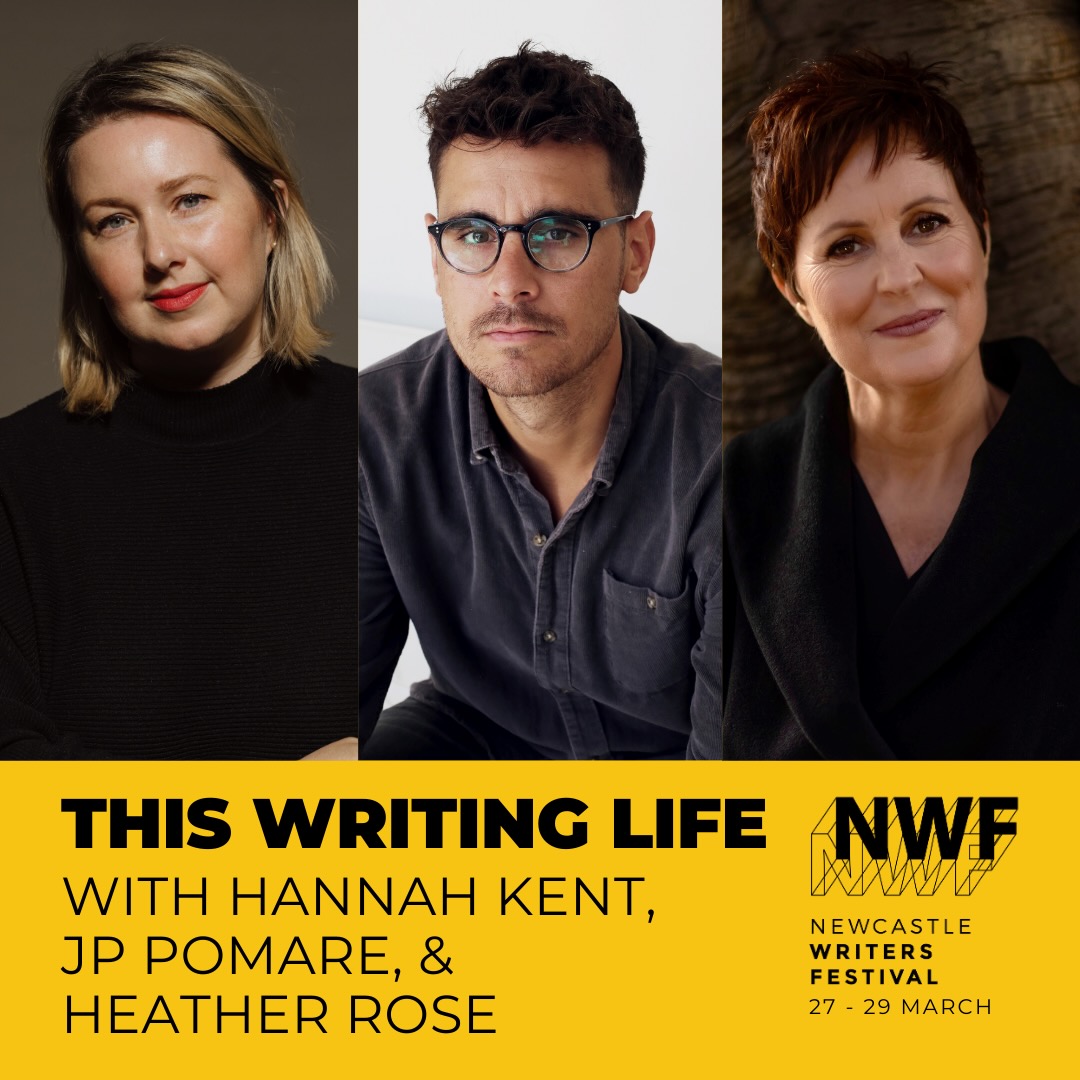
Saturday March 28th 10am I’ll be talking about The Writing Life with my two wonderful fellow writers – Hannah Kent (Always Home, Always Homesick, Burial Rights etc) and J.P.Pomare (The Gambler, Seventeen Years Later etc) guided by the one and only Kate Evans from ABC Arts. Tickets here.
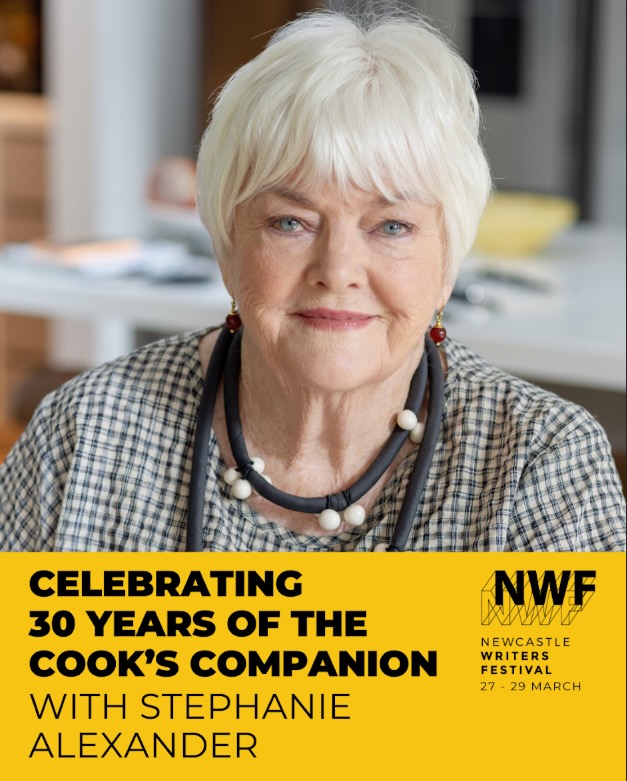
3pm Saturday March 28th I’ll be interviewing the extraordinary Stephanie Alexander AO celebrating the launch of the 30 anniversary edition of legendary Australian kitchen bible The Cook’s Companion. I’ve interviewed Julia Gillard, Elizabeth Gilbert and many other writers, but this one feels very special. Tickets here.
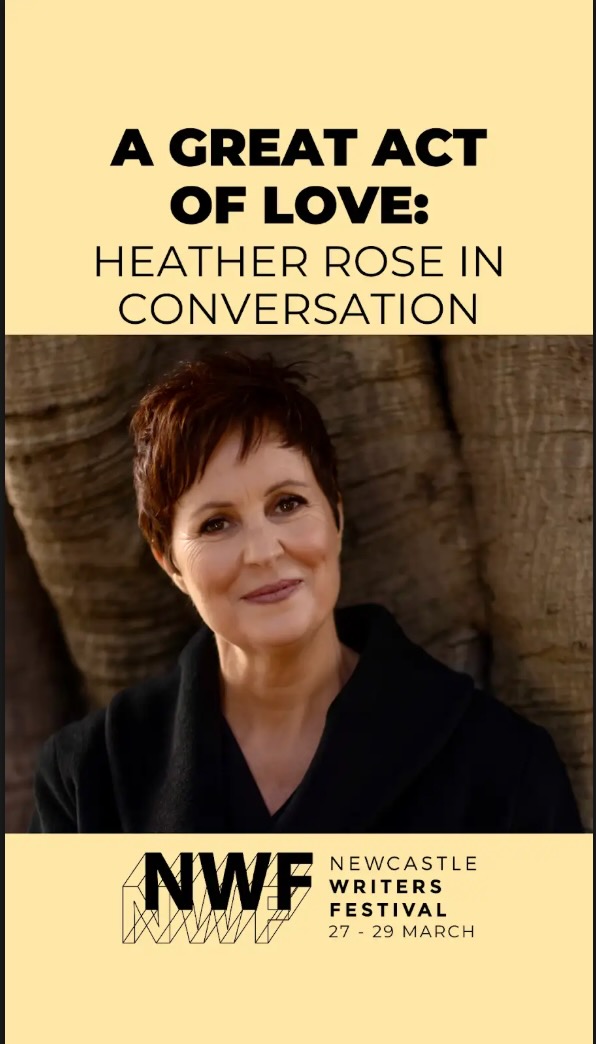
Sunday 5pm March 29th I’ll be in conversation with the wonderful Jacinta Parson talking about A Great Act of Love. Tickets here.
Please come along. there are so many brilliant writers across the entire Newcastle Writers program. Link here to all ticketed events.
T
Events and conversations at Newcastle Writers Festival 2026
Screenshot
Thank you to all the wonderful interviewers who shared the launch of A Great Act of Love with me through October. We began with Mel Kembrey in Hobart for the offical Tasmanian launch, then moved to Kate Evans in Sydney and Brisbane, Michaela Kalowski in Sydney, Jason Steger at Queenscliff, Sarah MacDonald at Avalon, Caro Baum at Thirroul, Helen Waugh in Sydney, Tracee Hutchison at Montalto on the Mornington Peninsula, Toni Jordan in Melbourne, Shelley Davidow in Noosa, Karen Viggers in Canberra, Stephen Lang in Maleny and Hannah Kent in the Adelaide Hills and Cassie McCullough and Kate Evans in Canberra.
Thank you to all the beautiful booksellers, hosts and staff at inner city venues, delightful wineries, beautiful restaurants and awesome libraries from the Adelaide Hills, to Maleny and Noosa, to events at Sorrento, Queenscliffe and Canberra Writers Festivals.
Thank you to all the readers and fellow writers who shared their love along the way.
And to Allen & Unwin, publishers extraordinaire, for all the planning, logistics and care.
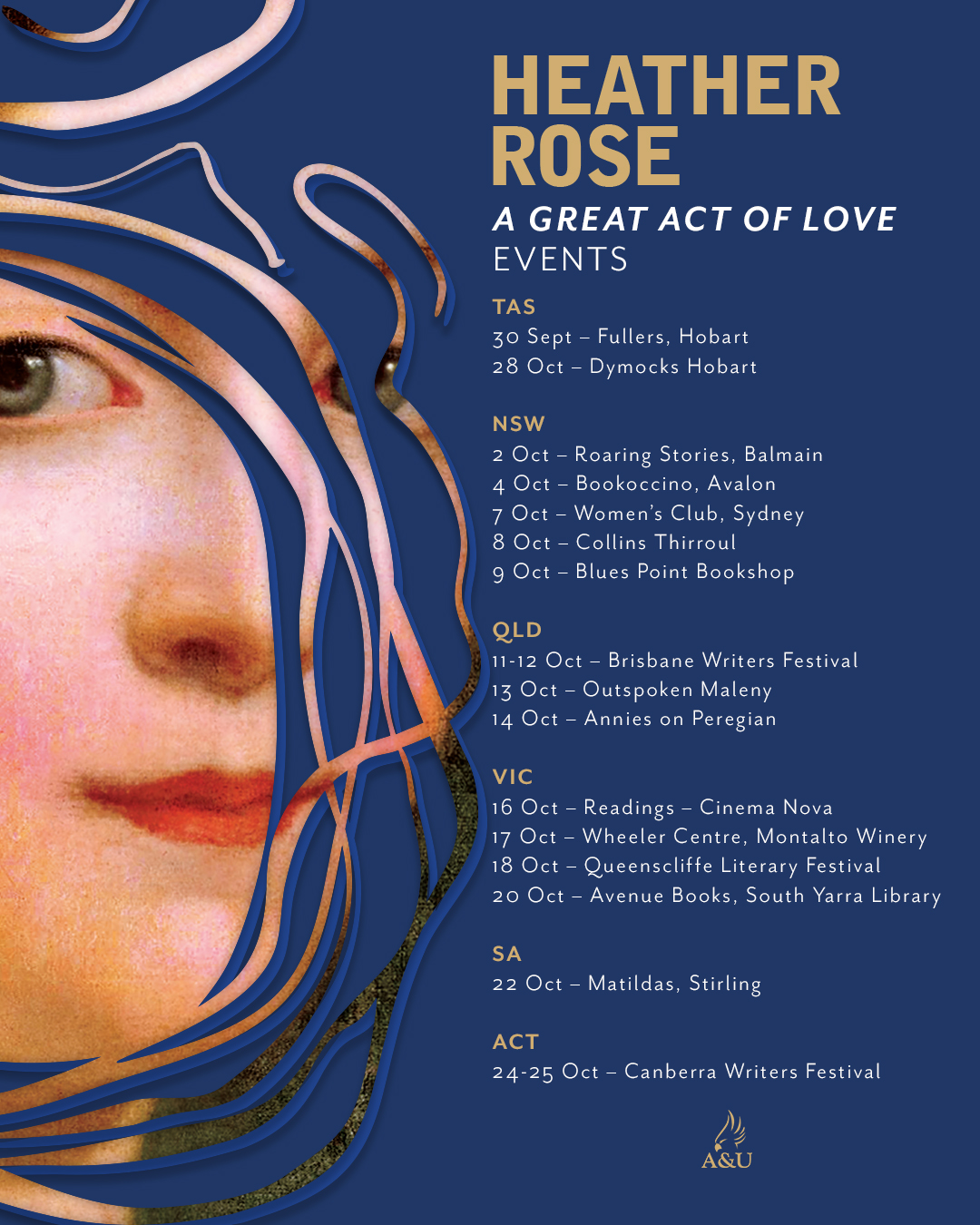
A Great Act of Love Events
Murder, theft, reinvention and redemption – a novel of family, legacy and love.
2:30pm – 3:30pm | Nothing bad ever happens here: Heather Rose in conversation with Danielle Wood
I’m delighted to be in conversation with my dear friend and fellow author Danielle Wood reflecting on The Museum of Modern Love and Nothing Bad Ever Happens Here. Click here to book a free ticket.
Danielle is the author of the Vogel Prize-winning novel The Alphabet of Light and Dark, Rosie Little’s Cautionary Tales for Girls, Housewife Superstar: the very best of Marjorie Bligh and Mothers Grimm. As ‘Minnie Darke’, she’s written the novels Star-crossed, The Lost Love Song, and With Love from Wish & Co, and the novellas Wild Apples and The Yellow Wood. Danielle is also the co-editor of two anthologies of Tasmanian writing, Deep South: Stories from Tasmania and Island Story: Tasmania in Object and Text. And together Danielle and Heather Rose are ‘Angelica Banks’, author of the Tuesday McGillycuddy books for children. Danielle lives in Hobart and teaches writing at the University of Tasmania.
Award-winning author Amanda Lohrey sits down with poet and editor Michelle Cahill to talk about hope and trust in literature. Click here to book a free ticket.
Michelle Cahill (she/they)
Michelle is a poet and novelist of Indian heritage. She is the 2023 Hedberg Writer-in-Residence. Her short story collection Letter to Pessoa was awarded the NSW Premier’s Literary Award for New Writing. Her novel Daisy & Woolf was longlisted in the ALS Gold Medal and the Voss Literary Prize. She has been shortlisted in the ABR Elizabeth Jolley Prize, the Peter Porter Poetry Prize and received the KWS Hilary Mantel International Short Story Prize. Cahill is the artistic director of Mascara.
Amanda Lohrey (she/her)
Amanda lives in Tasmania and writes fiction. In November 2012 she received the 2012 Patrick White Award for literature. Her 2020 novel The Labyrinth won the 2021 Miles Franklin Award, the Voss Award for fiction, the Prime Minister’s Award for fiction and the Tasmanian Literary Award for fiction. Her most recent publication is a novel, The Conversion (2023). In 2022, Melbourne University Press published a critical study of her work, Lohrey, by Dr Julieanne Lamond of the Australian National University.
At Last! The launch video is here. Please enjoy. It’s been such a busy year so apologies for the long delay in posting this.
Also because you may not have an hour, I’ve created 4 short ‘chapters’ with The Speeches, The Interview, The Thank Yous and The People – so you can choose the section of the event you’d like to watch.
My huge thanks to Michael Gissing who created these films. And to my brilliant publishers Allen & Unwin.
I am delighted to be attending Bellingen Readers & Writers Festival in June. I’ll be in conversation about Nothing Bad Ever Happens Here with the wonderful Mel Kembrey on Saturday June 10th and I’ll be interviewing the extraordinary Heather Mitchell and Akuch Kuol Anyieth about Life and Words on Sunday June 11th. Plus a surprise session to come. The Festival program in online here. Book quickly!
I’ll be in conversation with Jacinta Parsons talking about Nothing Bad Ever Happens Here and the writing life with fellow author Kate Legge (Infidelity and Other Affairs) on Sunday, May 7th at the State Library of Victoria. Come along!
Update: So sorry to be unable to attend this one due to unforseen circumstances. Thank you Kate Legge and Jacinta Parsons for creating a wonderful one-on-one conversation!
At Adelaide Writers Festival this year, I was privileged to be interviewed by Guardian Editor, Lenore Taylor. Here’s the interview via Spotify.
‘Joy is my daily practice’: Heather Rose on overcoming tragedy and choosing to live a happy life
From dancing into other worlds in North America to losing her vocabulary in the Australian desert, the Stella prize-winning author is taking nothing for granted
The old wooden house looks out over the sea. Standing on the upstairs balcony of Heather Rose’s house is like being on the prow of a becalmed ship.
At the far end of the gently curving Tasmanian beach, forest runs to the sea. Rose swims across this bay at sunrise every morning, even through the frosty months when there is snow on the mountain, in only a bathing suit. Electricity shoots up her arms when she first goes in; her breathing is ragged, but when the shock subsides it is an “elixir of sea and sky”. The cold water leaves her radiant, her face shining with health. It has taught her “a certain fearlessness”.
One morning, back when the author used to wear a wetsuit, a huge fish slid in beside her. It was a dolphin, she writes in her memoir Nothing Bad Ever Happens Here, “regarding me with its huge dark eye”. Then she was in the middle of six dolphins slowing their pace to swim with her. “They are choosing to accompany me.” In the luminous early morning sea the air is filled with rainbows in the spray as the dolphins leap and dive. She thinks this might be death. “I was quite surprised,” she says now, “to see the shore was still there.”
Another day she was on the beach and saw a cloud bank that looked like a bridge to nearby Bruny Island. It would become an actual bridge in her bestselling, sometimes satirical political thriller Bruny, and she would blow it up in the first chapter. That was an idea that came to her at three in the morning and gave her such a fright that she shot straight up in bed.
As a child Rose had spent holidays on Bruny Island. “It was wild and wonderful. It was rare to find another set of footprints on the beach. I remember having to put shoes on again at the beginning of the school year and my feet were so leathery that it would be painful for days trying to squish my feet in.”
To meet Rose is to be enveloped in warmth and joy. “I’m in love with this planet and the people who inhabit it,” she writes in her memoir. But it is not until you come to the last chapters of the memoir that you understand how hard won this has been. Rose has chosen to live with joy.
Rose is a sixth generation Tasmanian. The island and its natural world is in every fibre of her being. She needs this weather to write: “I love weather that glitters off the river as it ambles past.” All of her life she has had visions. When she was 12 she dreamed of a drowning. That same day, her 15-year-old brother Byron and her grandfather drowned in Saltwater River. The tragedy fractured her family; her mother did not come back from her grief, and left the family for another man. Rose says Byron would appear to her and tell her not to be afraid of death: “Maybe that was also part of my commitment to a passionate life. I think I was always searching.”
Much later in her life, Rose would swim in the river where her brother and grandfather died. “Then it occurs to me,” she writes, “that nothing bad happens here.
When she was a young mother working as a freelance copywriter in advertising, she kept dreaming of two wolves with red-gold eyes. She was told by a spiritual person that she was being called by the spirit to a Native American sun dance. For four years she travelled to North America to go through sacred ceremonies that involved food and water deprivation, and dancing from sunrise to dark for days in the heat until “I lost my sense of a limited world”.
Back in Australia she put her pipe, feathers, herbs and beads away and hoped that normality would return. But it didn’t. “I felt like a wind vane attuned to a weather system of energy,” she writes. “I could feel the pain and suffering in people I passed in the street.” Then a man she had met at a sun dance invited her to the Central Desert to dance, insisting the experience would ground her.
It was there that one day, sitting in the shade after a midday meal, Rose looked up and saw two rainbows “in a perfect circle” around the sun. She recalls seeing a figure emerge within the orb of the sun: “When it reaches me, a blast of electricity fells me. I drop into nothingness.” The people who experienced it lost their faculties for hours, days or months, she says. Rose lost her vocabulary and had to learn how to do the most basic things again. She still doesn’t know what happened: “We just know that something way outside the normal human experience happened to us all.”
It was months before she could go back to work. When she came home to a house full of books, she could see, she says, that this was “something very important”. But she says she “literally had to learn to read again”. “It was very strange to not have vocabulary, especially because I could see that was something you really needed in life.” But she felt blissful: “I was never scared but it was sometimes very difficult to simply operate in the world. I remember going to a supermarket for the first time and being completely overwhelmed, all those experiences were heightened to such an extent that I lived very very quietly. It was very strange.”
Ultimately, as a mother of three, running a successful advertising agency, she found the sacred in everyday life. And she will write her books at night. “The world settles down, the phone is not going to ring. The night is very protective. ”Still it must have been exhausting. “I’ve always had a lot of energy. That’s been very helpful. Also my children were very energising to me.”
“Every book demands more than I think I can give,” Rose writes. “Every novel, every book, takes everything.”
Rose has written three children’s books and five novels. Her seventh book, The Museum of Modern Love, which reimagines Marina Abramovic’s 2010 performance of The Artist is Present at the Museum of Modern Art in New York, won the 2017 Stella prize. It was written over 12 years, while Rose was working on other books and projects. “It took so long because I had so much else going on. I remember thinking, how many drafts have I done? I could see about 72 in my records. Those characters seemed to demand a certain precision in themselves as well. So sitting with each of them and sharing their lives and listening to what they had to say, it was a really soothing novel and a lesson in craft.”
The Stella prize was a “beautiful gift” because the wider readership it brought her meant she could write full-time; before her win, she once got a royalty cheque for 57 cents.
Her latest book, Nothing Bad Ever Happens Here, was originally written as a way of collecting her stories for her children. “Travel stories, stories about food, their favourite recipes, from time to time my explorations into the mysterious nature of the world.” A private person, she went through “quite a bit of anguish” before sharing her stories with the world.
It is devastating to find out, in the last chapters, that Rose has done all of this while living with chronic pain and ankylosing spondylitis, an arthritis that inflames ligaments, muscles and joints, which can immobilise her for months and weeks. At its worst, she writes, “there is red pain and yellow pain, purple pain and blue pain, and there is the white pain of complete and utter surrender”.
But she says the illness has “heightened the magic of life”. She takes nothing for granted: “Not the act of walking, or my heart beating quietly in my body.” Joy, she says, “is my daily practice”. It is as essential as food and water. It is an act of will. It is full of love, it is shared and it is irresistible.
“It’s good here,” she writes, “It’s good it’s now. I’m so glad it’s now.”
By Susan Chenery, Oct 28, 2022
Nothing Bad Ever Happens Here by Heather Rose is out on 1 November through Allen & Unwin ($32.99)
Heather Rose – Bruny Island
07/06/2019
Hobart Tasmania
photography Peter Mathew
You are a UN
conflict resolution expert based in New York. Your brother is the Tasmanian premier.
Your sister is the Tasmanian opposition leader. Your mother has cancer and your
father is sliding into dementia and speaks only in Shakespearean quotes.
Someone blows up
part of an almost-completed $2bn bridge joining Tasmania to its offshoot Bruny Island.
You, dispatched to the scene, spot a bloke who looks as if he’d know how to
handle explosives, but on the plus side he resembles Chris Hemsworth.
Welcome to the
weird, wonderful, sad, nervous, bold and hilarious interconnected world of
56-year-old Astrid Coleman, the lead character in Heather Rose’s new novel
Bruny, named after the 362sq km island at its centre, permanent population
about 600.
“The whole book was
the most amazing amount of fun I’ve ever had writing in my life,” the author
says. “I laughed and laughed.”
Rose’s family has
lived in Tasmania for six generations and Bruny Island, accessible only by
boat, has been important to her throughout her life. It was a place of fun and
games for Rose as a kid and it has been a place of peace and quiet for her as a
writer. A lot of that laughing during the writing of the novel, which is part
thriller, part political satire, part romance, was due to Astrid’s formidable
presence in Rose’s life.
Some writers treat
their characters as galley slaves. They tell them when to row, where to go and
when to stop. Others live with their characters, have conversations with them,
are guided by them. Rose is in the latter camp. “Yes, my children think that is
strange,” she admits.
Astrid, better
known as Ace because as a child she cheated at cards, even came to her in a
dream and suggested — perhaps demanded is a better word — an important
development in the plot.
“That night she
wiped me out with something so shocking it left me sitting up in bed,” Rose
says.
Rose used to argue
with her characters and sometimes try to say no to them, but she has stopped
doing that now and is more comfortable with the relationship as a result.
“I think that’s the
trick, isn’t it? I’m so grateful that Astrid only came at this point (Bruny is
Rose’s fifth novel for adults). I might have tried to push her around if she’d
come earlier, but this time I just let her have her head, and I was shocked by
her so many times.
“She’s quite an
outrageous character and she says things about life, men, politics, ideology,
everything, really, and I would type it all out, look at it and think, ‘I can’t
say that. That’s terrible. And then I’d think, ‘Oh, well, Astrid said it.’ ”
Here’s a good
example, when Astrid, who has two grown children, is thinking back on her
failed marriage: “Everyone should have to get divorced from the person they’re
married to, just to see who that person really is.”
Bruny is Rose’s
first novel since The Museum of Modern Love, centred on Serbian performance
artist Marina Abramovic, which won the 2016 Stella prize. It is also the first
one she has been able to write full time, thanks to the Stella cheque and an
Australia Council grant. Rose, 55, dabbled in modelling and acting when she was
young but has earned her living as an advertising copywriter, then as
co-founder of an award-winning advertising firm, Coo’ee Tasmania. She has three
grown children.
“The Museum of
Modern Love took me 11 years. It was a very long process. I wrote four other
novels in the meantime, and it was a tedious novel in so many ways. Sorry.
“There was a
gruesomeness to writing it. It was arduous. It took everything, that novel. And
then, it had all the success, which was such a surprise. Then on the back of
that, the Australia Council, for the first time after 10 applications over 23
years, gave me a grant to work on this novel.
“I had already been
coming up with a few thoughts about it and writing scenes and all of that. But
there was something so brilliant about being able to knuckle down with this
idea that the Australia Council had funded me to write a political satire about
Australian government.”
After that
explosive set-up, Bruny unfolds as a power and passion drama about family,
loyalty, home, place, politics, foreign investment and love. It is in part a
love letter to the author’s home state.
Yet Tasmania is a
familiar but estranged place for Astrid, who has lived most of her adult life
in New York. She returns to help her twin brother, John, the Liberal premier,
known in the family as JC, a man who can walk on water, who is set to go to the
polls in four months. He has asked her to bring together the opposing sides in
the bridge debate, the established Tasmanians and the greenies versus the
newcomers, the developers and the Chinese investors, so the bridge can be fixed
and opened before the election.
The opposition
leader, Maxine, is their older sister. She is the one who has continued the
family tradition as she is the Labor leader. Their father, Angus, was a state
Labor MP for decades. JC switched sides.
“If this book is a
love story, it is a love story for my fellow Tasmanians,” Rose says. “There’s
no way I could do justice to this community without talking about the
spectacular visual beauty we live in every day and how much that colours our
life.
“But I also can’t
help but observe Tasmania and what we’re seeing in terms of visitor numbers and
consider what that means in the next five years, in the next 10 years, in the
next 20 years.
“And when I was
writing the book, I was immersed in current affairs, to everything that was
coming out of the US, the UK and here in Australia. I do think it’s important
we have better conversations about our national security planning, about our
long-term economic planning … and about what on earth are we doing about
protecting ourselves from the climate emergency.
“Clearly we do not
have leadership on any of those fronts. One of the things that I enjoyed doing
was looking into the nature of democracy.”
The novel is set in
the near future, which turns it into a delightful guessing game for readers.
Who is the prime minister? (Hint: I think it’s a comeback.) Who is the king of
England? Who is the American president? Who is the bestselling writer-public
intellectual greenie camped on Bruny Island? (Hint: I don’t think it’s Richard
Flanagan.)
I’m not going to
spoil the fun for readers, so I’ll leave the possible name out in this example.
When I say to Rose that the federal minister for natural protection Aiden
Abbott, better known as Aid-n-Abet, is obviously … she laughs and nods. A
friend of Rose sitting with us chips in. “You’ve been very naughty,” she tells
the author, who laughs some more.
As well as the name
game, other tantalising questions linger from the outset. Who blew up the
bridge? Why? Is it an act of terrorism? Is the brother-sister political
opposition just a front that allows one family — Coleman Inc — to control the
state? Does China have Australia’s interests at heart or are we just part of
its “chequebook colonialism”?
And is Astrid
working for someone else other than the Premier? Early on she notes “I have to
hide the truth, that’s always been my speciality”, and wonders: ‘‘Would I ever
kill for an ideal?” A reader’s impression of what that ideal may be will shift
as the novel goes on.
The Shakespearean
quotes from Angus are not just there for fun. This novel has Shakespearean
undertones. Readers will think of Lear, The Merchant of Venice, The Tempest and
especially Hamlet, where one can “smile, and smile, and be a villain”. No one
is exactly who they seem to be.
“It’s beautiful as
a writer to be part of a lineage,” Rose says. “I think as a writer it’s very
hard to ignore the influence of great writing, especially what’s been given to
us in the dramatic realm. And of course Shakespeare is so political.”
The political
intrigue at the centre of this novel is the result of a lot of research. Rose
spoke to friends and contacts who worked in, or had connections to, political
parties, security agencies, government authorities and the UN.
She was
particularly nervous about the scenes where the bridge is blown up, worried
that readers in the know would tell her she didn’t understand the nuts and
bolts of it.
So she made contact
with explosives experts, people similar to her fictional former paratrooper now
bridge foreman who looks like Hemsworth.
“They did come back
to me,” she says, “and were willing to advise me, but on one provision. They
said: ‘This is for a work of fiction, right?’ ”
Bruny, by Heather
Rose, is published by Allen & Unwin (424pp, $32.99).
LITERARY EDITOR Stephen Romei is The Australian’s literary editor. He blogs at A Pair of Ragged Claws and can also be found on Twitter and Facebook. @PairRaggedClaws
Dymocks Sydney – George Street – Bruny their October Book of the Month
My first book tour is over. Bruny has been launched across Australia. Thank you to all the bookstores that so graciously and delightfully welcomed me and Bruny to author events across the country. It was such a pleasure to meet readers everywhere, brilliant booksellers, and to discover so many beautiful bookstores! Apart from the events below, there were also so many signings at independent bookstores and Dymocks stores in every city. Thank you all!
My thanks to the very dedicated and brilliant publicist from Allen & Unwin – Christine Farmer – who made all this happen … and visited endless shopping centres with me for signings. Also to Ange Stannard and Maria Tsiakopoulos in WA and Victoria who chaperoned me in those states. Also to the awesome Allen & Unwin team who designed all the Bruny collateral that decks windows and bookstores across Australia. So wonderful to have this kind of support for a novel.
Events were held at:
Hobart Sunday Sept 29 3.30pm Fullers Bookshop In Conversation with Literary Editor of the Australian, Stephen Romei
HobartTuesday Oct 1 6pm Official Bruny Launch Hobart RACV Hotel 6pm with Premier Will Hodgman and supported by Dymocks – SOLD OUT
Sydney Wednesday Oct 2nd 6.30pm Better Read than Dead In Conversation with Editor of The Guardian, Lenore Taylor
Wollongong Friday Oct 4th 6pm Wollongong Art Gallery In Conversation with author and journalist Caro Baum
Perth Sun Oct 6th 4.30pm National Hotel Fremantle with New Edition Bookstore In Conversation with ABC Perth’s Gillian O’Shaughnessy
Perth Mon Oct 7th 6.15 for 6.30pm Beaufort Street Books In Conversation with Jane Seaton
Brisbane Tuesday Oct 8th 6.15 for 6.30pm Riverbend Books In Conversation with Suzy Wilson
Brisbane Wednesday Oct 9th 6 for 6.30pm Avid Reader In Conversation with award-winning author Rohan Wilson
Adelaide (Stirling) – Thursday Oct 10th 6.30 for 7pm Matilda’s Bookshop In Conversation with Gavin Williams
Melbourne Friday Oct 11th 6.45pm for 7pm – PLEASE NOTE CHANGE OF VENUE: Avenue Bookstore, 127 Dundas Place, Albert Park In Conversation with James Ley – SOLD OUT