


Each week, Benjamin Law asks public figures to discuss the subjects we’re told to keep private by getting them to roll a dice. The numbers they land on are the topics they’re given.
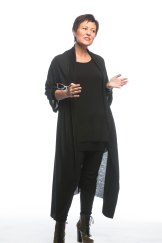
The Hobart-based author won both the Stella and Christina Stead prizes in 2017 for her seventh novel, The Museum of Modern Love.
POLITICS
How would you describe yourself politically?
I’d say I’m a Blue Green.
What’s a Blue Green?
Green is someone who cares passionately about the environment, social justice and for the long-term good of humanity and the planet. Blue is for the old-fashioned liberal values of egalitarianism, economic growth – not, however, at the expense of the quality of human life.
What party represents those values?
There isn’t one. I always find myself appalled by how we seem to have arrived in the 21st century with a world that is so deeply unjust to the great majority.
Does it make it hard for you as a voter?
Completely, but I always vote Green. You have to vote for the planet and human rights.
Where do you think you get your politics from?
My father is a Labor voter and my mother is a Liberal voter. Bizarrely, I grew up in Hobart equidistant between neighbours who’ve gone on to both become senators: one in the Greens, one in the Liberal Party. I’ve ended up in a world where I’m much closer to my Green colleagues, but I’m not a pure socialist: I think everybody deserves to benefit from personal endeavour.
Could you date someone with fundamentally different politics to yours?
[Laughs.] Maybe not.
MONEY
Was money a fraught thing for you, growing up?
Both my parents worked to put my sister and I through private school. No one in my family had ever got a degree, so education was really important. However, it was tight. My parents were really smart about caring for money. We didn’t go on holidays – we didn’t have that kind of income – so we lived very simply. My grandparents built a shack for us on the Tasman Peninsula, so we spent holidays there. Other than that, we went camping. Camping is my idea of money well spent.
Do you feel like you’ve been good with money?
I’m good at making money and making a business profitable. [As well as penning seven novels, Rose has run advertising agencies, sat on arts and corporate boards in her home state and founded a luxury accommodation business in Hobart.] In my personal life, I’m very good at saving. But I’m also very good at spending; I really love beautiful clothes.
What do you consider a waste of money?
Nights you never remember! A lot of designer stuff to me is excess, in a world where we need to have better priorities. There’s a gluttony to the world of the designer that I find really abhorrent.
What constitutes the “beautiful clothes” you like, then?
Beautifully designed, beautiful fabrics. It doesn’t have to cost thousands of dollars. I have one designer I absolutely love: Alistair Trung. He’s my absolute go-to. His designs are magnificent, his fabrics beautiful.
You have three children. Have you ever sat down with them and said, “This is how you save money”?
I’ve given each of them a copy of George S. Clason’s The Richest Man in Babylon. It’s all about being respectful of your money, making sure some of it is saved, some of it is put away for everything you need to live on. So with my kids, when they got pocket money, I would say, “Even if you’re getting $10, $1 of that you have to save.” Great: you’re teaching them fractions at the same time. Indeed!
DEATH
You’re 53. How would you like to die?
I want to die very old, in a really warm chair, with a good blanket. My hair is white. My children …
You’ve thought about this!
I have! I saw it recently: my children, grandchildren and great-grandchildren are somewhere about. I’m in a house with glass windows and the sun’s coming in. Someone in the house really loves me, especially, particularly and deeply. It’s afternoon, and we’ve just had some beautiful celebration. Possibly my 104th birthday. And I close my eyes.
And that’s it.
Yep. That’s a pretty great death.
Do you fear death?
Not at all.
Why not?
I’ve nearly died several times.
Really? How?
Heart problems. And I’ve been quite reckless as well, in my life, when I was younger.
In what ways? Or, in what ways can you share?
It’s going in the memoir. [Laughs.]
What happens to us when we die?
I think we go on. My sense is we have a soul. I know Christopher Hitchens would be cross with me for that.
Does that matter?
Yes! I feel like he’s still out there.
Well, if what you’re saying is true, he is.
I feel there is some mystery that is absolutely evident to all of us on this planet. It’s either that we get recycled and we come back in another life. Or that we live all these lives at once because time is completely an illusion, like physicists remind us. Or we get reabsorbed into the magnificence. I don’t know. But from what I’ve seen of death, someone – or something – comes to get us. And if something comes to get us, then there’s something beyond.

Writer, author of The Family Law and Gaysia.
An Artist Who Explores Emotional Pain Inspires a Novel That Does the Same
Heather Rose’s novel, “The Museum of Modern Love,” is a part-fact, part-fiction tale of art, love, grief and convergence.

Nov. 26, 2018
Credit Joe Wigdahl for The New York Times
SYDNEY, Australia — Heather Rose checked into the Chelsea Hotel after a long-haul flight from Hobart, Australia, flung her bag in her room and sped to the Museum of Modern Art.
This was the spring of 2010, and Rose had a mission: to stare into the eyes of Marina Abramovic, the Serbian-born performance artist, in the atrium of the gallery.
“I thought I could just walk up and be the next person,” said Rose, the novelist whose new book, “The Museum of Modern Love,” will be published by Algonquin Books of Chapel Hill, a division of Workman Publishing, in the United States on Nov. 27.
“I’d never seen people running for art,” said Rose, 54, who remembers people racing to get to the front of the line.
Rose was one of 850,000 people who attended Abramovic’s 75-day performance, “The Artist Is Present,” in which visitors waited for hours to take a chair opposite the then 63-year-old artist and share a meditative gaze with her for any length of time. People described transformative experiences. Many wept through their mute encounters.
Marina Abramovic’s art performance, “The Artist Is Present,” is where the lonely characters of “The Museum of Modern Love” all independently arrive.

Marina Abramovic’s art performance, “The Artist Is Present,” is where the lonely characters of “The Museum of Modern Love” all independently arrive.
Credit Ruth Fremson/The New York Times
“It was as if they were seen in a way they’re not normally seen,” Rose said. She returned every day for three weeks. She watched the crowds and saw others came back, too.
This atrium and this exhibition, with the silent Abramovic at its heart, is where the lonely characters of “The Museum of Modern Love” all independently arrive. Just as Rose was, they are inexplicably drawn to this refuge of unspoken, intimate connection and stillness in Midtown Manhattan.
This part-fact, part-fiction tale of art, love, grief and convergence is Rose’s fourth adult novel (she is also a co-author of the “Tuesday McGillicuddy” children’s series under the pen name Angelica Banks) and won Australia’s Stella Prize in 2017.
The characters — including Arky Levin, a film composer who hasn’t visited his ill wife in months; a widow taking the vacation she and her husband always meant to take together; and a grieving art critic finding solace in an affair with a married man — move through New York yearning to be seen.
In one desolate moment, Arky believes his estranged wife has left her toothbrush on the sink and searches high and low for his own, realizing days later it was his toothbrush he had seen and that he “only recognized it in relation to Lydia’s.”
Questions of loss appear throughout the book, but Rose doesn’t feel the need to resolve them. “It’s not trying to be definitive,” Professor Brenda Walker, the chairwoman of the 2017 Stella Prize judging panel, told me. “It’s trying to be open and thoughtful.”

CreditPatricia Wall/The New York Times
The book is narrated by an unnamed artist’s “muse,” an incorporeal angel-like being that’s assigned to watch over artists. Different muses have visited Rose for each of her books, she told me recently over dinner at a Sydney restaurant. This one was patient, thankfully, as the novel took her 11 years to write. (Other times, she said, it’s a little old woman with a bamboo stick whacking her on the back, saying: “Write harder! Write longer!”)
She had become used to writing “around the edges of the days,” juggling family and running an advertising agency she co-founded in 1999. Thanks to various book prizes and a grant from the Australia Council in 2017, Rose is now writing full time.
As a proud sixth-generation Tasmanian, Rose orders the Tasmanian pinot noir with our meal, and effuses to me about the landscape: “We have the best clouds in the world!”
This novel is her first not set in Tasmania, but she spies unlikely connections between Manhattan — another island, she points out — and her home state.
Island culture “gives us a sense of identity, and maybe that makes us more robust in our creative output,” she said. “Big Apple, little apple,” she affectionately calls Manhattan and Hobart, the capital of Tasmania.
The spark of the book came five years before “The Artist Is Present.” Rose had never heard of Abramovic until she encountered photographs of the artist’s previous performance works at the National Gallery of Victoria in Melbourne, Australia, in 2005. She saw images from the 1988 work, “The Lovers,” in which Abramovic and her partner, Ulay, each walked more than a thousand miles from different ends of the Great Wall of China to meet in the middle and end their relationship.

Heather Rose was deeply moved by Marina Abramovic’s 1988 work, “The Lovers,” in which Abramovic and her partner, Ulay, each walked more that a thousand miles from different ends of the Great Wall of China to meet in the middle and end their relationship.CreditThe Marina Abramovic Archives
“Instantly I thought, there’s a character for a novel,” Rose said. How could someone be so brave and courageous, she wondered, yet so vulnerable and romantic?
She tinkered with the idea for years (she published her third novel, “The River Wife,” in the meantime). But it wasn’t until she sat opposite Abramovic in MoMA that she realized she couldn’t fictionalize her.
“She’s too powerful, she’s too magnetic,” Rose said. “Nothing I could imagine would be more interesting than what she’s done with her life.”
Rose nervously wrote to the Sean Kelly Gallery, which represents Abramovic, and got the artist’s blessing. Rather than relief, it brought a fresh wave of anxiety for Rose. “I didn’t want to let her down in any way,” she said.
Abramovic was not let down. “I really loved the story,” she told me recently, and she wrote a glowing blurb that appears on the back of the book.
Rose never interviewed Abramovic for the book (“It’s a bit like breaking the fourth wall,” she said), but researched her life meticulously, thanks largely to the collection of materials belonging to David Walsh, the owner of the MONA gallery in Hobart.
While immersed in Abramovic’s four-decade career, Rose understood another reason she was drawn to the woman who had made an art out of enduring extreme pain.
Rose has had an inherited arthritic condition since childhood, which has, many times, left her unable to walk for weeks. She’s never talked about it publicly.
“So actually, writing is really painful for me,” she said. “And so pain is one of those things I’ve had to befriend. I think of it as a house guest that’s stayed way too long.”
She ponders how much of herself she poured into the book without even realizing it. Rose’s marriage ended six months before the novel’s release in Australia, yet she had instinctively populated her book with resilient female characters rising above grief, suffering and recurring illness.
“I feel in retrospect that what I was writing was a kind of blueprint for the sort of life I needed to live beyond the marriage, even though I had no idea the marriage was failing at the time.”
The book is launching with an event this week where it all began: at the atrium in the Museum of Modern Art, with Abramovic herself.
“I couldn’t quite believe that, honestly. I thought, she has a huge life, and this is just a little novel written by a Tasmanian,” Rose said.
“I’m still nervous to meet her,” she said, laughing. “I’m a huge fan. The funny thing is, I wasn’t a fan when I first started. I was just curious.”
Follow Tacey Rychter on Twitter: @taceyrychter.
International conflict resolution specialist Mary Dwyer lost her husband Adrian to cancer. His death was infused with a sense of wonder and spirit. Mary’s beautiful memoir documents the journey of a family losing the one they love and navigating it all with courage, joy, gratitude and grace.
Here is Sarah L’Estrange on Radio National’s Books & Art having a chat with me about writing The Museum of Modern Love – and how real life events created a world of characters and ideas.

On radio


