


A lot of unexpected things have happened this year. It’s a beautiful, brilliant year in the face of some great personal hardship. It’s strange the way life does both, but it seems to be the way it is. I am immensely grateful for it all! I am delighted to find my work reaching a wider world of readers, and I am deeply touched by the acknowledgement for so many years of hard work.
Along the way, there have been quite a few interviews, reviews and articles. This article by Jane Sullivan, published in the Age and the SMH, utterly surprised me (and totally delighted my Dad who has patiently waited to see if my books would ever be ‘discovered’ by people further afield.)
The first William Faulkner novel I read was As I Lay Dying. I must have been about 21. From there I read every novel of Faulkner’s, settling at last on Light in August as my favourite – and one of my top five favourite novels of my lifetime. I think it comes as close as any novel to being a perfect novel in form, characterisation, in tone and in the spectacular craft of good writing. So to find my words compared to Faulkner’s made my father cry, and me reflect on the wonder of life.
We never know how our creativity will touch other lives. For me that is a mysterious gift and a privilege that may yet keep me writing all my days.
It’s not easy to let the recognition in. But given everything that has unfolded, I wanted to acknowledge this very special observation by Jane Sullivan.
Here is the link to the article – and the complete text is below should the link fade.
“What a winning acceptance speech Heather Rose gave for the 2017 Stella Prize. She charmed everyone in the room: she was humble, honest and a little bit steely. To survive as a writer you need steel.
She liked to think of her winning novel, The Museum of Modern Love, as an overnight success. In fact it took 46 years from the moment her father told her a terrible thing when she was six years old.
She’d read him her poem about a rabbit, and he said, “You’re going to be a great writer.” For years she was devastated by the huge gulf that existed between her own writing and that of the great writers.
There was progress. Two failed novels; a first published novel (she remembers only the one unkind review); a second novel that once delivered her a royalty cheque for 57 cents in a 60-cent envelope; a third novel with ardent fans, but very few readers; a series of stories for children, written with Danielle Wood.
The Museum of Modern Love took 11 years to write, was rejected by Australian and US publishers, and finally found a home with Allen & Unwin. Somewhere along the line Rose accepted she would never be a great writer. But she wants nothing more than to continue to write.
This is literary success in Australia. But what about in the world. Something prompted me to compare Rose’s words with the indisputably great writers’ award acceptance orations of the past, so i went to the Nobel Prize website and had a look. You know what? I preferred Rose’s speech. It seemed to resonate more.
The Nobel prizewinners whose speeches I found were all men. They usually began with a dutiful nod to humility, and some of them kept up that note. But others became Godlike. They made stirring calls to the writers of the future (who they assumed were men) and told them what they should be writing about. I began to think that if their dads had ever told them they’d be great writers, they’d just take that as their due.
Of course I found rhetoric and grand pronouncements about literature that are still frequently quoted. Faulkner thought the writer must write about nothing but “the old verities and truths of the heart … love and honour and pity and pride and compassion and sacrifice”. Hemingway thought the writer must always try “for something that has never been done or that others have tried and failed”. Steinbeck believed that “a writer who does not passionately believe in the perfectibility of man has no dedication nor any membership in literature”.
These writers were speaking on a world stage, at a time when the world seemed a dark place at risk of nuclear annihilation. It’s still dark, though perhaps a different kind of darkness. Rose was speaking on a small stage, to an Australian audience, mostly women, after winning a prize for women. Inevitably it’s a speech about smaller, personal things.
Or is it? “Being a successful woman is not an easy path,” Rose said – especially in Australia, and she cited the case of Julia Gillard. And then she, too, rose to the challenge of defining the task of the writer: “to tell our stories. To reflect the human experience. To find what is common and what is uncommon. To explore the past, be with the present, to imagine the future … And if we do not foster our creativity when we hear it calling – whether in our children or as adults – then the world is poorer for it.”
None of those great men mentioned children.”
Janesullivan.sullivan9@gmail.com
The Stella Prize was established in 2011 when a group of bold, brave women took the step of acknowledging that Australian women writers were being under-represented in the books reviewed and the prizes that were awarded. For example, in 2011, 70% of books reviewed in the Weekend Australian newspaper were written by men. And the ultimate literary prize in Australia, the Miles Franklin – the legacy prize of one of Australia’s great writers (and a woman) – had only been won by a female author 10 times in the 54 years it had been awarded. So the Stella Prize was born.
It’s hard to express how meaningful it can be to have the books we write acknowledged by a wider circle of people. Publishing is not a world awash with funds to promote books. For literary writers, the most we can usually hope for is a good review in a major newspaper. But that doesn’t always happen. Sometimes the support of enthusiastic distributors and bookshop staff can promote a book, or a lucky invitation to a writer’s festival. Sometimes there are rare moments that see our works transformed into films or plays or video games. Almost as rare is the sale of our work into foreign countries. Invitations to festivals are not easy to come by. I have attended one major festival. It was with my first novel – White Heart – at Sydney Writer’s Festival. That was in 1999. Festival budgets do not stretch to flights and accommodation for largely unknown authors from far flung regions of Australia. And there’s the catch. Without publicity we cannot achieve sales. Without sales we cannot forward our careers.
British publishers do not generally pick up novels already printed in Australia. US publishers are just as tough. And even when we are picked up, there are rarely any royalties that flow beyond the initial (and sometimes quite modest) advance. The average advance in Australia for a novel is $5000.
Prize money is a gift of time. Prize money is so rare! Any money for writing is rare! And every prize has different eligibility criteria. Because The Museum of Modern love is set in New York, with no reference to Australia at all, it is ineligible for the Miles Franklin which is only for books that ‘present Australian life in any of its phases.’
Writing is hard work. It requires enormous focus and stillness. It requires creating an almost meditative space where we can convey the story that is urgently trying to flow through us. That urgency can obliterate all other thoughts. It is devastated by interruption. It is dissuaded by a failure in the writer to just sit down and do the work.
Writing takes time. Because it is very rare for Australian writers to earn any substantial income from their work (currently the average income for Australian writers is $13,000 pa) we must then do our work around other work. Writing a novels usually takes years. That’s years where writers have to choose writing before the other demands of life. In my experience what gives is socialising, movie-going, tv watching, gardening, cooking, renovating, reading, sleep and any other number of ways we humans spend our time.
So it’s something of a miracle when, after many years of work, a book with it’s own special life beyond the clandestine world of the author’s mind and the author’s computer, finds its way onto a major prize shortlist. And the Stella shortlist is a huge boon. It will have a significant impact on the number of readers who discover a book. It gives the book a profile that opens up the possibility of sales into other countries and other mediums. For a little while we ride on a bubble of acknowledgement. And it’s precarious. Like a flower in bloom. We know there are other days ahead, other cycles to come. So it’s important to celebrate.
I think for most of us writers, it’s always a surprise to receive widespread acknowledgment for our creative efforts. This fragile idea that came to visit, that was gathered up and written down and worried over for months and years and became a novel or a work of non-fiction or a prose or poetry collection, is the result of a kind of fight against all the odds. If the book gets published that is the first miracle. If it attracts a shortlisting for a major prize that is another miracle. There are so many good writers and good books.
So thank you Stella judges for whittling down your longlist to a Stella shortlist 2017 that includes The Museum of Modern Love. I am enormously and profoundly grateful.
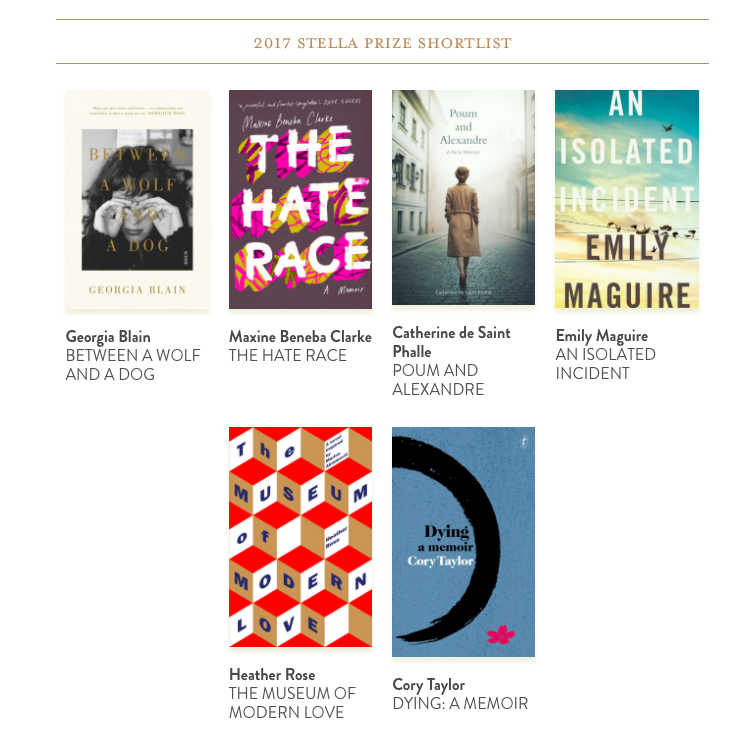
Stella shortlist 2017
‘The Museum of Modern Love’ has been included on this extraordinary longlist of Australian literature. Thank you Association for the Study of Australian Literature! The Medal has a distinguished history and previous winners include Michelle de Krester, Gillian Mears, David Malouf and Christos Tsiolkas.
The ALS Gold Medal is presented annually by the Association for the Study of Australian Literature (ASAL) for a ‘work of outstanding literary merit’ published in the previous calendar year. Last year’s winner was Brenda Niall’s Mannix (Text).
2017 Long list announced for the ALS Gold Medal
Adam Aitken One Hundred Letters Home (Vagabond)
Steven Amsterdam The Easy Way Out (Hachette)
Georgia Blain Between a Wolf and a Dog (Scribe)
Peter Boyle, Ghostspeaking (Vagabond)
Michelle Cahill Letters to Pessoa (Giramondo)
Tina Giannoukous Bull Days (Arcadia)
Dennis Haskell Ahead of Us (Fremantle)
Fiona McFarlane The High Places (Penguin/Hamish Hamilton)
Zoe Morrison Music and Freedom (Vintage)
Sean Rabin Wood Green (Giramondo)
Heather Rose The Museum of Modern Love (Allen & Unwin)
Rajith Savandasa, Ruins (Hachette)
Australian Literary Society medal
The ALS Gold Medal is awarded annually for an outstanding literary work in the preceding calendar year. The Medal was inaugurated by the Australian literary Society, which was founded in Melbourne in 1899 and incorporated into the Association for the Study of Australian Literature(ASAL) in 1982.
The medal was originally awarded for the best novel published in the previous year but, since 1937, other literary forms have been eligible for consideration. The medal has sometimes been called the Crouch Gold Medal after its principal benefactor, Colonel R.A. Crouch
No nominations are required, though ASAL members are invited to propose potential winners to the judging panel.
Michael Cathcart and Radio National’s Books & Arts have a lovely section called Top Shelf. In this 10 minute edition I’ve shared a few cherished memories across art, film, music, novels and a Mary Oliver poem http://www.abc.net.au/radionational/programs/booksandarts/top-shelf:-heather-rose/8075752
Here is the review for The Age by the wonderful Louise Swinn for The Museum of Modern Love. Utterly unexpected and totally appreciated. This review also appeared in the Sydney Morning Herald – see above.

Great literature
Not long ago I was asked to judge the Jean Yates Writing Prize for 2016 for year 11 & 12 students at Hobart’s Friends School. Along with the awarding of the prize, I was asked to give a speech about why reading matters. It caused a bit of a stir – so here it is in full.
WHY READING GREAT LITERATURE MATTERS
I know that about half of you, when you heard the word ‘speech’, drifted off. I’m inviting you to drift back and be present. Great. Thank you.
So, you’re in year 11 & 12 – at one of the most elite schools in Tasmania – and no doubt all your schooling life you’ve been told that reading and writing matters.
But let’s say you gave it up. You decided that you were only going to read Facebook or Twitter feeds – your texts and your emails.
You might read a bit of Buzzfeed and check in with John Oliver from time to time … maybe you’d click on a few links that take you here and there …laugh at the day’s Ninegag jokes – but basically you stop reading.
And when you wrote things you only posted comments on Facebook – or YouTube. You sent a few emails and a fair few texts. Slowly you used emojis more and more. Wrote another thousand texts, another thousand emails, and another thousand posts.
And really … would life be so much worse?
But pretty soon, if everyone did that, we’d be back to hieroglyphs. And somewhere on that trajectory, we’d have gotten pretty limited in our thinking. In a world currently threatened by people who have limited thinking, that seems a very unwise route to take. Ignorance is a cancer we do have a cure for. But it has to be treated every day.
Still maybe books have gotten old. Maybe they’ve gone out of date. I mean real books are kind of bulky and they don’t have a built in torch or a Spotify app.
But if we stopped reading, how would our stories be remembered? We are, after all, storytelling animals. And if we lost the craft of good writing, who would write the great speeches that change our society? Who would write the great characters that teach us to empathise with other people and other lives? Who would debate the bigger things in life – our innate sense of loneliness, our underlying lack of connection? Where would all the stories for the movies come from?
When I talk to primary school children I tell them it doesn’t matter what they read – comic books, graphic novels, poetry, picture books, children’s novels – it just matters that they read. Getting in the habit of reading – and then I can only hope that they get the reading bug – that will take them on into better and bigger and bolder books.
But at your age it does matter what you read.
For three reasons. Firstly, you are Tasmanians – you live at the bottom of the world and everyone – when you head out there – across Bass Strait and beyond to study or work – everyone will think you had a lesser education – no matter what school you went to.
And secondly – the reason it matters what you are reading – is because everyone else out there isn’t reading. It’s likely that the people sitting on either side of you today are not reading. Our devices have replaced our books as our travelling and life companions. But if you want one thing – just one thing – to set you apart when you enter the world of employment and find yourself up against the five hundred other kids with your same degree and your same good looks, your same service record and your same sense of entitlement – because they too are from good homes – the one thing that will set you apart – is the life experience you have gained within the pages of the hundred great classic novels – and that’s just a starting point.
By the time you’re 25, if you start now, and you read a novel a week approximately, you could have read 400 great novels – and not long after that – you’ll have read 1000. Every one of them is a step out of being like everyone else – to being uniquely you. Because reading is a deeply creative process. It helps you to know yourself. And getting to know ourselves is the real job we humans have.
When you know yourself, employers see that – future partners see that. Bank managers see that. They may not be able to put their finger on it. Elsewhere they might put it down to the fact you’re a Tasmanian – after all, everyone knows we’re a bit different. But really it will be that you have honed not simply your mind – and also your heart and your soul.
There is nothing like your imagination – your very own imagination – left to explore itself through the pages of great books – to craft you into the person you glimpse that you would like to be.
You’ve learned the first and most vital trick to creativity thanks to life in a Quaker school. Sitting in silence. So beyond here, apply it. Practice sitting in silence and avoiding the desire to reach for a device. The magic won’t take long to happen. Your imagination will begin to entertain you. Watch it flourish.
And here is the third reason why reading good literature matters.
As a person who has also spent thirty years in advertising, let me tell you that self-aware, imaginative and happy isn’t what the economy needs you to be. The economy needs you to be fearful, unhappy and ignorant. Because fearful, unhappy and ignorant people buy things. They buy things every day. They fill up their homes, they fill up the landfill, they fill up the planet. And that makes the current economic model work.
Happy people simply don’t need to fill up their lives with things. They fill up their lives with ideas.
Every new gadget you feel you need, every new piece of clothing, every new status symbol you yearn for and every dumbed down news report you consume, every hour you spend in unproductive social media, TV shows, HBO and Netflix, is an hour you are not creating anything.
And what happens when you don’t create anything? You get unhappy. And what happens when you get unhappy? You get fearful. And then you buy things. It’s very simple. We are rats on a wheel of emotional starvation. Emotion, want, buy, consume – and round it goes. So there you have it. The perfect consumer cycle.
Unhappiness is a nasty thing to live with. I’m sure some of you already know that. Creativity can lift you away from all that.
It is like the difference between cleverness and intelligence.
As the philosopher Eckhardt Tolle says – ‘Cleverness pursues its own little aims. Intelligence sees the larger whole in which all things are connected.’
And reading literature – reading great literature – is the fastest way to see how all things are connected.
Your school education is almost at an end. Beyond here you’re on your own. So get educated – but stay educated. Get creative – but stay creative. Wake up. But stay awake.
Books are your short cut. Books may take time – but you will become a faster reader. They may not be simple – but your mind will become more complex. They may not be easy to carry – but audio books are. They may not be contemporary. That’s ok, you won’t be either in a few years time.
If you have any sense that you want to live a big life, then get off the rat’s wheel of social media and fast food tv, consumption and mindlessness and get engaged in literature. The surprising outcome will be that you get satisfied.
You’ll find your sense of isolation, your underlying loneliness diminishes. What you read and write on social media, in texts and emails, is not what will take you there. But I assure you, reading the great novels will.
Heather Rose, October, 2016.
The Age & The SMH published this article on the writing of The Museum of Modern Love.
The essay is here too (and without the ads!)
The writing of The Museum of Modern Love
As a writer you hear lots of stories about the writing process. How sometimes novels are written fast. How novels come through like tuning into a radio frequency and all the writer has to do is simply transcribe them. William Faulkner, it is said, wrote As I Lay Dying in 6 weeks while he worked nights as an attendant in a parking garage. This is not one of those stories.
The Museum of Modern Love has had at least five titles as it emerged. It was initially written as a first person narrative, then from seven different first person perspectives, then in the third person, and now it’s back to a sort of first person narrative. (Read it, you’ll understand). And it took eleven years.
It all started on a visit in 2005 to the NGV to see the Dutch Masters. I wandered into a side gallery and found a black and white photograph depicting a table set with some grey shadowy shapes. The small panel beside the photograph described a performance piece called Rhythm 0 by Marina Abramovic. In Naples in 1974 Abramovic had laid a table with 72 items – these included a rose, a bottle of olive oil, a loaf of bread, a feather, chains, a whip, a knife, a gun and a single bullet. For six hours Abramovic was completely passive. The audience stripped her, cut her, wrote on her face, chained her to the table, and someone loaded the gun, put it to her head and attempted to make her pull the trigger. The descriptor continued with a short biography noting that Abramovic had also walked the Great Wall of China with her once-lover and performance partner Ulay as a symbolic gesture to end their relationship.
Reading that short panel I thought, ‘Now there’s a story.’ And it took hold. I had just written The Butterfly Man – a novel based on the disappearance of the infamous British peer, Lord Lucan. Another novel about water, fish and transformation was already underway. It was called The River Wife. The early writing of that novel won an international fellowship in 2006 with the Varuna Foundation that took me to Scotland for a month in Edinburgh as a guest of the UNESCO City of Literature. There I would write a first draft of The River Wife which was published by Allen & Unwin in 2009.
At the end of the time in Edinburgh I drove north and then out to the Isle of Skye, where I’d lived and worked through a long, wet summer in 1983. There, in a small hotel, on a quiet summer evening, a story really began to form in my mind of a character based on Marina Abramovic who had given her life, and her love, to art. I went upstairs around 10pm and wrote until 5am. At the time, I thought I was really onto it. That this would be a quick novel. That it would simply flow through me. How wrong I was!
When you’re a mother of three children, a wife, when you run a family business and have some interesting health challenges, life gets pretty full. So the novel had to fit in around the edges. This is often the lot of female artists. We do not get the focused, protracted, uninterrupted periods of thinking time that have often been the bastion of male artists. We must allow our minds to work while we’re ferrying children, doing washing at midnight and cooking pancakes at 7am. And I had to complete The River Wife for publication. It was the priority.
But while The River Wife was emerging, I also kept at the ‘Marina novel’, as I would come to refer to it. In those days there was very little on the internet about Abramovic. And much of what was there was written in Italian or Dutch. So in those first years I worked solely from my imagination. Then I happened upon the library of David Walsh, creator of Tasmania’s brilliant art gallery – The Museum of Old and New Art (MONA). At that stage the museum was a large shed in the back blocks of Hobart and the library was a series of small partitioned spaces and a couple of cupboards stacked with boxes. The site for the Museum would soon be excavated, but like my book, it was still more an idea than reality.
One of the cupboards became my research space. Here was every book ever published about Marina Abramovic. It was like discovering my family history. I felt pieces of understanding falling into place. And then someone mentioned to me that Marina Abramovic was doing a show at the Museum of Modern Art (MoMA) in New York in 2010 and I knew I had to be there.
I had been to New York before and despite believing myself to be a person much better suited to remote beaches, old forests and wide blue skies, I surprised myself by falling in love with that beautiful evocation of city. So going back felt easy. I took a room again at the Chelsea Hotel (complete with worn brocade velvet couch, Harlequin-tiled bathroom and upright piano). It turned out to be one of the last months the Chelsea would still be the Chelsea before renovations would get underway that have no doubt removed the decades of creative emollient that so lubricated the place. From there, every day for several weeks, I went to MoMA to see Abramovic’s 75-day endurance performance The Artist is Present.
I sat opposite Abramovic, and met her gaze, four times. I interviewed her gallerist, Sean Kelly and her photographer Marco Anelli. I talked to people who were there watching and participating in the performance. And I wrote. I can never sleep in New York so there were long nights at my laptop, and long days sitting on the floor of MoMA waiting in the queue to sit, or simply observe.
You might think that from there, it would be easy. But it wasn’t. Because in seeing Abramovic, in visiting her Retrospective, I realised I could never create a character based on her. It would never do her justice. Any art I could think of was always going to be surpassed by her real story. So I requested of Marina that she be a character in the novel. She said yes. And it began to fall into place.
However it’s not easy to put an extremely powerful Serbian (who is still alive) at the heart of your story. For a long time I grappled with my fear. Writing is all about overcoming fear. But this felt like a PhD’s worth of fear. And there were the normal issues with structure, voice, dialogue… and the other characters who were not always forthcoming. Perhaps they were intimidated by Marina too. One enormous blessing was that with MONA built, David Walsh gave me a studio to write in, and I became the inaugural writer-in-residence in 2012-13. It was a sanctuary.
In 2010 I had also begun writing a children’s book with my friend Danielle Wood, under our pseudonym Angelica Banks. The first book led to a series that is published internationally. So suddenly we had intense deadlines. But these books were exactly the sort of delightful literary reprieve required when you are dealing, on the other hand, with a novel about marriage, love and art.
The third book in the children’s series was published in May this year. It’s called Blueberry Pancakes Forever. And now at last after 11 years, The Museum of Modern Love will be published this month. It’s the story of a film composer, Arky Levin, whose marriage is facing an excruciating reality. He is drawn to MoMA to observe the woman in the red dress who is meeting the gaze of whoever sits in the chair opposite. And life unfolds.
Curiously, the world of imagination has begun to mirror the world of fact. While I was writing The Museum of Modern Love, I began a degree in Fine Art. But that’s another story.
Heather Rose
August 2016
The Museum of Modern Love is published this month by Allen & Unwin. Heather Rose is the author of seven novels. She writes for both adults and children and has been shortlisted, longlisted or won awards for crime writing, sci-fi/ fantasy and literary fiction. She lives by the sea in Tasmania. www.heatherrrose.com.au
Up now at The Wheeler Centre is this interview.
Heather Rose is a novelist, art student and businesswoman, who writes for both adults and young readers. Her seventh novel, The Museum of Modern Love, is out now. Heather chatted with us about Leo Tolstoy, Edith Wharton and her dream of founding a School of Imagination.
Here’s a link to a Q & A for the Tasmanian Writer’s Centre Up Close & Personal following the launch of The Museum of Modern Love. Created by the wonderful Ruth Dawkins @dorkymum.
If you’d like a little insight into what it takes to write a novel, this is an article I wrote on The Museum of Modern Love that appeared today in The Age and also the Sydney Morning Herald. The Age – The Steady Gaze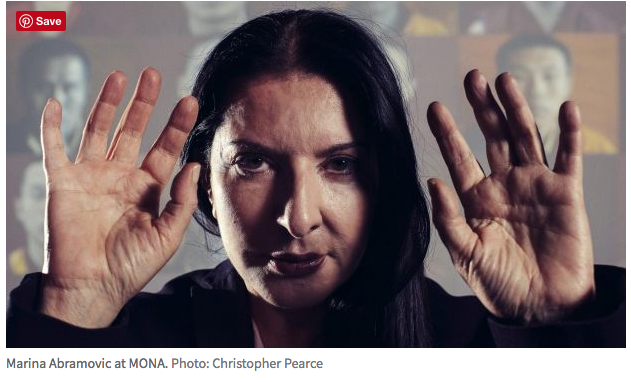

To anyone who wonders how long novels take to write … well, sometimes they take a very long time. Here is the cover art of my new novel – The Museum of Modern Love – about to be published in Australia September 2016. It’s taken 11 years. I did write 4 other novels in the meantime – but it’s been a lesson in endurance. As the cover suggests, it’s about art – and also marriage. And Marina Abramovic is a character in the novel. I hope you enjoy it.
Every year, in the hinterland of the Gold Coast, a most remarkable celebration of children’s literature takes place – the Somerset Celebration of Literature – at the Somerset College. Angelica Banks was lucky enough to be one of the thirty authors for 2016. It’s hard to express the scale of this festival. There are literally thousands of children streaming in from across Queensland to listen to authors and engage in sessions about books and words and writing.
One group of primary school students travelled 12 hours from Rockhampton by train for one day at the festival. Another had travelled 6 hours by bus.
From the extraordinary students who provide individual valets for each writer to ensure we can navigate the large campus and find our marquees, to the book shop team, the catering team, the green room team, the people who set up and put away everything it takes to create this festival, right through to the brilliant drivers who chauffeur us to various destinations, the school staff, and the teachers who make everything possible – bringing their students to experience and explore the love of literature – this is a festival that is full of heart.
Here we are about to start a workshop session wearing our Angelica Banks summer garb – having traded our long blue velvet coats etc for hats – given the 30 degree heat and 90% humidity.

Angelica Banks at Somerset Celebration of Literature 2016


